AI-Driven GTM Imagery: Part 1, Strategic Foundations
What the LLM Needs Before It Makes Anything

In the first piece in this series, I laid out the five-stage process for making production-quality marketing graphics with AI. The turkey dinner analogy: you can’t ask a chef to cook four-course Thanksgiving if all you give them is potatoes. They need the turkey, the cranberries, the drippings, the herbs. The same logic applies to creative production with LLMs. You have to bring the ingredients before you ask for the meal.
Stage one of that process is strategic foundations. It is also, in my experience, where most teams stall out completely. Not because the work is hard (it’s not, conceptually), but because marketing teams have a documentation problem that engineering and product teams solved years ago. Everything that makes a brand distinct lives in people’s heads. Not in files. And if it’s not in files, the LLM can’t use it.
This piece is about what “strategic foundations” actually means in practice, why it matters more than any tool you’ll ever choose, and how to get yours into shape even if you’ve never done this work before.
The Work That Most Marketers Have Never Touched
This stage is going to feel very familiar to all my product marketing friends and branding and communications friends. For everyone else, you have very likely never done this work yourself before. It’s always been done by someone else, either a management consulting firm or a senior leader in your company. And you’re typically not involved because there’s a small group of people who make these decisions, and they don’t share the “why” frequently.
A lot of working marketers, even experienced ones, have spent their entire careers executing against positioning and messaging that somebody else created. They know what the tagline is. They know the brand colors. They can recite the value props from the pitch deck. But they’ve never been the person who decided those things, and they’ve never seen the reasoning underneath— especially in startups where this work doesn’t even exist yet (and is changing every day).
When you sit down to make creative with an LLM, that gap becomes a wall. The model needs to know what you’re selling, to whom, for what price, against which competitors. How you differentiate yourself from those competitors in the parts of the market where you want to position as experts. How you describe that to your target audiences most effectively. How you’re different and better. How you measure that or know it. Why the customer should believe it.
Pricing. Key messages. Value propositions. Reasons to believe. Stat sheets. Ideal customer profiles. User journey maps that show where those customers are at what point in their process and how to best reach them. Core features and benefits.
It’s a long list. And if you hand an LLM a prompt that says “make me Instagram ads for our spring campaign” without any of it, you’ll get something that looks like it could have been made for literally any company in your category. Superside’s 2025 research confirmed what I’ve seen firsthand: custom AI systems trained on documented brand context dramatically outperform generic prompts. The teams getting fast, on-brand output are the ones that invested in writing this stuff down. Everyone else is getting fast garbage and blaming the tool. This is why the tools that work best have two things in common: the most setup at onboarding (collecting extensive context) and >$1,000/month price tags.
Side note: I see a lot of people today referring to these strategic decisions as “taste”, which I take umbrage with. Do people with 15 or 30 years of lived experience have better intuition and judgement when faced with daily decisions— potentially very impactful and ambiguous ones? Yes. But I also believe that good judgement comes primarily from great data, and these strategic data are what you need to make good calls on those nebulous decisions— even without the 20 years of experience. “Good taste” comes down to, ultimately, better context. These strategic foundations give people more of that context.
From Strategy to Visual Identity
Once the strategic pieces exist (or you’ve collected them from someone who already made the decisions), the second half of stage one is translating that strategy into a visual brand guidelines playbook. Your creative director or agency of record would typically do this. Again, depending on where you’ve sat in your organization, you might not have had a lot of visibility into this process. But it’s where you give all the strategic context to a designer and make decisions about how the brand should feel in the market.
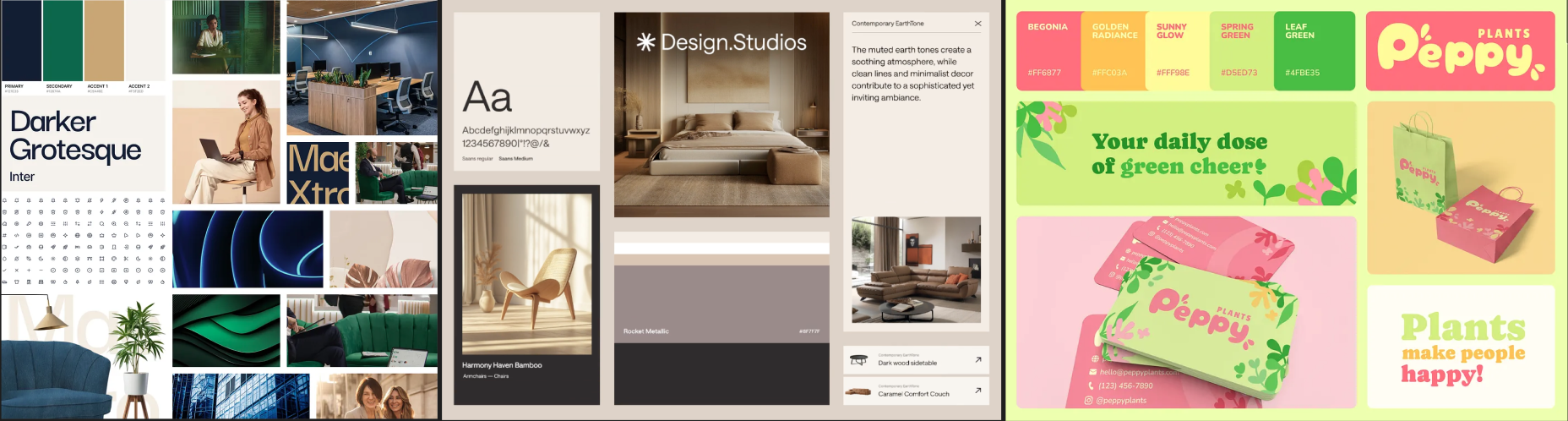
Do you want to be minimalistic and Scandinavian? Or brutalist and abrasive and disruptive and bright? Do you want a lot of open space between elements or do you want to feel dense and heavy? Do you want a black background with techie-looking type that makes it look like a command line interface because maybe you’re trying to come across as more technical? Or approachable and warm? Organic and fluid with brushstrokes and round shapes?
Those are aesthetic decisions. And they’re not arbitrary. They’re rooted directly in what happens in the strategy stage. Your competitive landscape analysis might show a part of the field where there’s white space, where you can position yourself to feel and appear very different from competitors. The visual identity needs to reflect that positioning. If your strategy says “we’re the premium, high-touch option in a market full of self-serve commodity tools,” your visual identity better not look like a SaaS template from 2019.
Kira Klaas, VP of Corporate Marketing at Later, framed this well: “I’d rather see a brand take a creative risk that’s aligned with their values than play it safe with generic AI-generated content that could come from anyone.” The alignment part is key. Creative risk without strategic grounding is just noise. Creative risk informed by a clear positioning strategy is how you stand out.
Calibrating Fidelity to the Situation
One thing I want to be honest about: you should absolutely question the level of fidelity you put into each of these pieces. Not every project needs a two-week brand workshop.
You might work with a client that already has positioning documents, brand guidelines, and messaging frameworks. All you need to do is collect them, make sure they’re current, and format them in a way that’s easier for the LLM to read. Maybe that takes a day.
Or you might have a client that has none of this. Then the question of how high-fidelity you want it comes down to budget and spend level. If the budget is low and you just need answers to these questions, this could be as simple as putting a one-sheet together and having a one-hour meeting where you get a download on what the client thinks the answers are. You do some research, buff it up, send it over for confirmation, and move forward. That’s the minimum viable version, and it works.
For a brand where the stakes are higher or the spend is larger, you could run multiple days or weeks of workshops. You could do primary research with customers. You could build out full journey maps with touchpoint analysis. The depth scales with the need.
But here’s what doesn’t scale down to zero: you need these inputs in some capacity for the LLM to do a good job making creative. The bran'd’s north star has to be written down for AI to follow it. A vague north star is still better than no north star at all.
The Documentation Problem Nobody Talks About
Marketing teams do not have a documentation culture the way that engineering and product teams do. That sentence has gotten more reaction than almost anything else I’ve written in this series. Because it’s true, and everyone knows it, and nobody knows what to do about it.
The biggest challenge marketing teams face in using AI to produce more work is not that these strategic underpinnings don’t exist. Most companies have made positioning decisions. They’ve chosen brand colors. Someone, at some point, decided on the value propositions and the target audience. The problem is that it’s all in people’s heads. It lives in a slide deck from 2023 that nobody can find. It’s in the institutional memory of whoever was at that offsite three years ago.
Eighty percent of marketers are using AI for content creation, according to HubSpot’s 2026 State of Marketing report. But 39% of creative leaders worry about the quality of AI output (per Superside’s Breakpoint research). That gap, between adoption and satisfaction, is almost entirely a documentation gap. Teams are feeding AI tools prompts without context and getting generic results. Then they conclude the tools aren’t ready.
The tools are ready. Your files aren’t.
Engineering teams figured this out a long time ago. They have READMEs, architecture docs, API specs, style guides, testing standards. All written down, all version-controlled, all accessible to anyone (including AI) who needs to understand the system. Marketing teams need the same discipline. Your positioning document is your README. Your brand guidelines are your style guide. Your messaging framework is your API spec. If those don’t exist as actual documents that a machine can read, you’re flying blind every time you open an AI tool.
What to Do?
If you’re reading this and realizing your strategic foundations are scattered or missing, don’t panic. You don’t need to build everything at once. But you do need to start, and the order matters.
- Take stock of what you already have versus what needs to be created versus what just needs to be written down. Most organizations have made these decisions. The answers exist somewhere, in someone’s memory, in an old deck, in a brand book PDF that hasn’t been opened in two years. Start by collecting what exists and putting it in one place. A single folder. Plain text or markdown, something an LLM can actually ingest.
- Fill the gaps with lightweight discovery. If you don’t have a documented ICP, sit down for an hour and write one based on what you know about your best customers. If you don’t have a messaging framework, take your top three differentiators and write one paragraph each on why a customer should care. If you don’t have a competitive landscape view, list your five closest competitors and write two sentences on how you’re different from each. None of this requires a consulting engagement. It requires an afternoon and honest thinking.
- Translate your visual identity into something precise. Screenshots and mood boards are maybe 40% effective as AI context. What works dramatically better is a design token file (JSON or similar) with hex colors, typeface names, spacing values, and texture rules that the model can reference exactly. Even a simple structured document that says “primary color: X, headline font: Y, button style: Z” gives the LLM ten times more to work with than “make it look like our website.”
When all of this exists in files, the output from any AI tool improves immediately. Not incrementally. Dramatically. You go from “that looks like a template” to “that looks like us.” That shift is worth every hour you spend on documentation.
Subscribers can access a free resource here of every strategic input your LLM needs before it touches creative production.
Next in this series: the copy bank. How to generate 50 to 100 headline and subheadline variations organized by persona, campaign goal, and messaging wedge, so you never start a creative production run from a blank page again.