AI Tool Review: Omneky — Can AI Actually Make Your Ads?
The short answer: Not yet, but it can help.
Why I’m Reviewing AI Tools
I spend my weeks inside AI marketing tools so you don’t have to.
As an AI-native growth marketer (or, as the cool kids are calling it, “growth engineer”), I build growth systems for businesses and marketing leaders using AI. Not the “sprinkle AI on a landing page” kind. The “replace an entire marketing department with one operator and purpose-built tools” kind. I’ve run marketing at American Express, Verizon, and UnitedHealth Group, and now I help companies figure out which AI tools actually deliver and which ones just demo well.
As a person who loves to build custom AI agents, workflows, and skills in my Cursor_CMO operating system, I have about 10K things I want to build at any point in time— so, I’m always looking for “off the shelf” solutions I can use, where able.
That background means I’m not reviewing these tools as a casual user. I’m evaluating them the way a growth engineer would: Can this actually plug into a real marketing workflow? Will it save time or create more work? And most importantly, does the output hold up when real money is behind it?
Think of these reviews like Good Housekeeping for AI marketing tools. I’m testing them in real client scenarios, with real brand guidelines, against real deadlines. If a tool earns a recommendation here, it’s because it survived contact with actual work.
The AI ad creation space is exploding right now. Every week there’s a new tool on Reddit claiming it can generate hundreds of ads in seconds. Most marketers I talk to are overwhelmed by the options and skeptical of the claims. Fair. I’m going to cut through that noise for you, one tool at a time.
I also put a guide together for you, linked at the end, for you to try my preferred method for making creative assets.
The Tool: Omneky

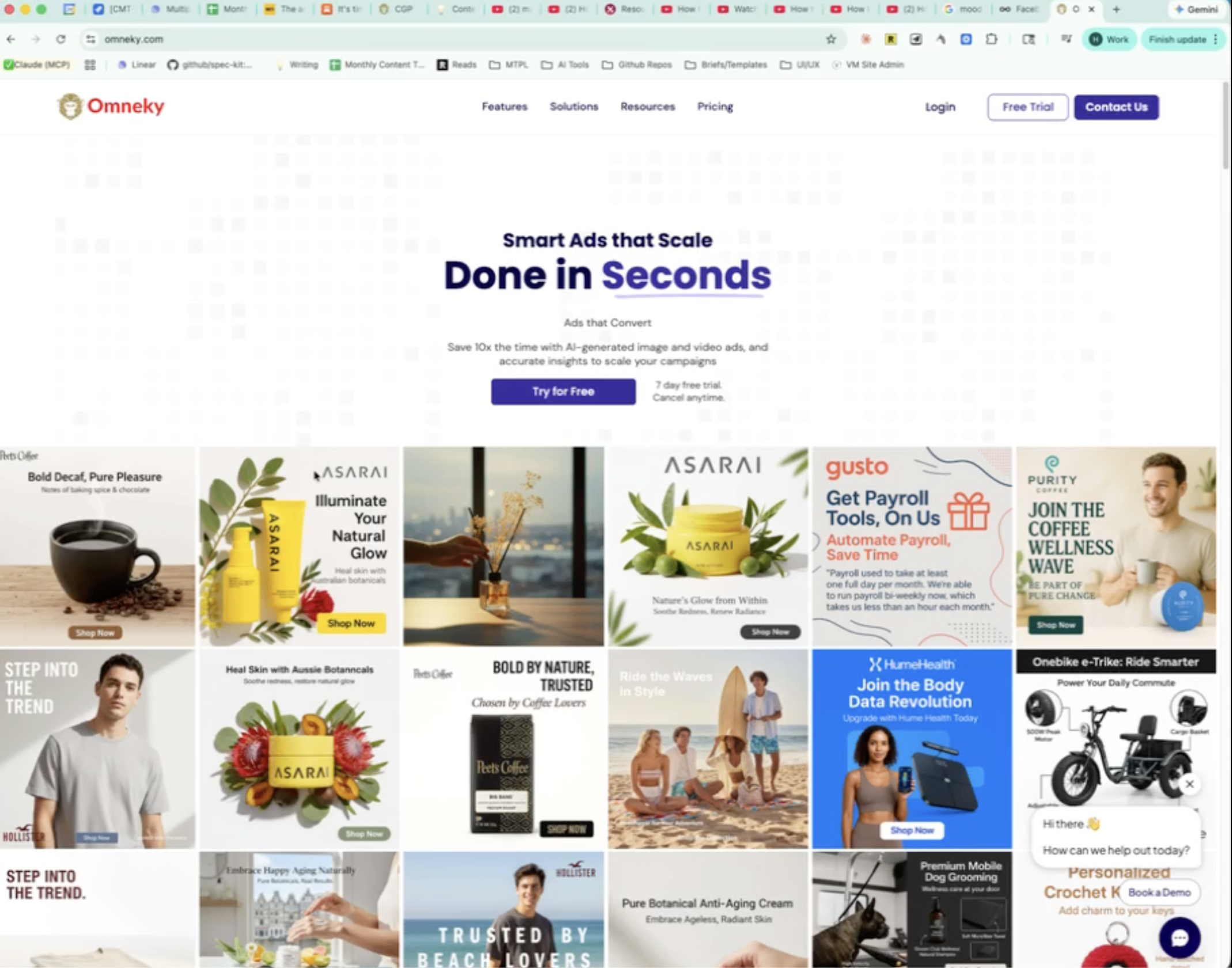
What it is: Omneky (yes, that’s how you spell it, though I keep wanting to say “Omni-key”) is an AI-powered ad creative platform that promises “smart ads that scale.” It generates static image ads, video ads, and even AI avatar videos from your brand inputs and performance data.
What it does: You onboard by telling Omneky about your brand, strategy, target audience, goals, and channels. You feed it a few example ads. Then it generates creative variations across formats. The platform also offers creative briefs, omnichannel campaign planning, and performance-driven iteration, where it connects to your ad accounts (Meta, Google, etc.), identifies your top performers, and generates new variations based on what’s already working.
Who’s behind it: Omneky has raised venture funding and positions itself as an enterprise-grade solution. Pricing starts at $99/month for the Standard plan, but the features most marketers actually want (multi-platform integration, performance insights) live in the higher tiers. They’ve built what they call a “Brand LLM” that’s supposed to enforce brand voice and guidelines across all generated assets.
How popular it is: Omneky carries a 4.7/5 rating on G2 from 700+ reviews, and it shows up constantly in Reddit threads about AI ad tools. It’s one of the more established players in a category that’s getting crowded fast.
Who they compete with: The direct competitors are Creatify (strong on short-form video, especially TikTok and Reels), AdCreative.ai (fast image and copy generation with Google/Meta integration), Superside (human-powered creative-as-a-service with AI assist), and of course Canva, which keeps bolting on AI features. Each has a different sweet spot, which I’ll get into below.
Bottom Line Up Front
Conditional recommendation. Omneky is a useful ideation and variation engine, but it is not a replacement for a real creative workflow.
Recommend for: Marketers who already have connected ad accounts and want help identifying winning creative patterns and generating variation ideas at speed. If you’re running Meta or Google campaigns and need a creative refresh pipeline, Omneky’s performance insights loop is genuinely valuable.
Do not recommend for: Anyone expecting to generate finished, ready-to-run ads without touching them. The output needs editing, and editing flat-file ad images is a pain. If you don’t have a Figma or Canva workflow to receive and refine these outputs, you’ll hit a wall fast.
Best for: Mid-stage marketers managing live ad accounts who need creative velocity and are comfortable with a “generate then refine” workflow. Not for beginners, not for teams expecting turnkey creative.
What I Liked
Onboarding is fast and intuitive. You give it your brand, answer a few strategy questions (who you sell to, what you sell, what channels you’re running), upload some example ads, and it starts generating. No 45-minute setup wizard. I had initial outputs within minutes.
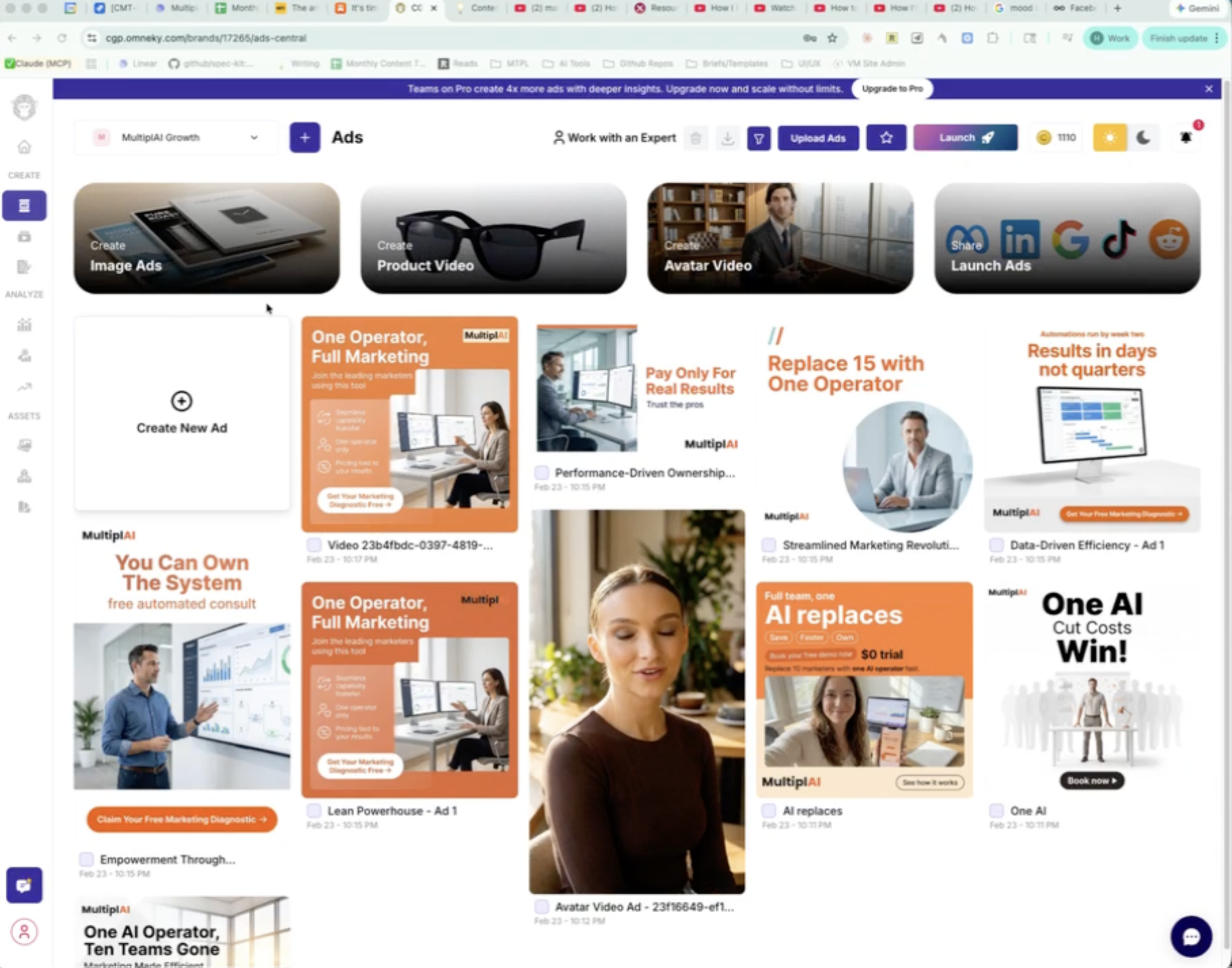
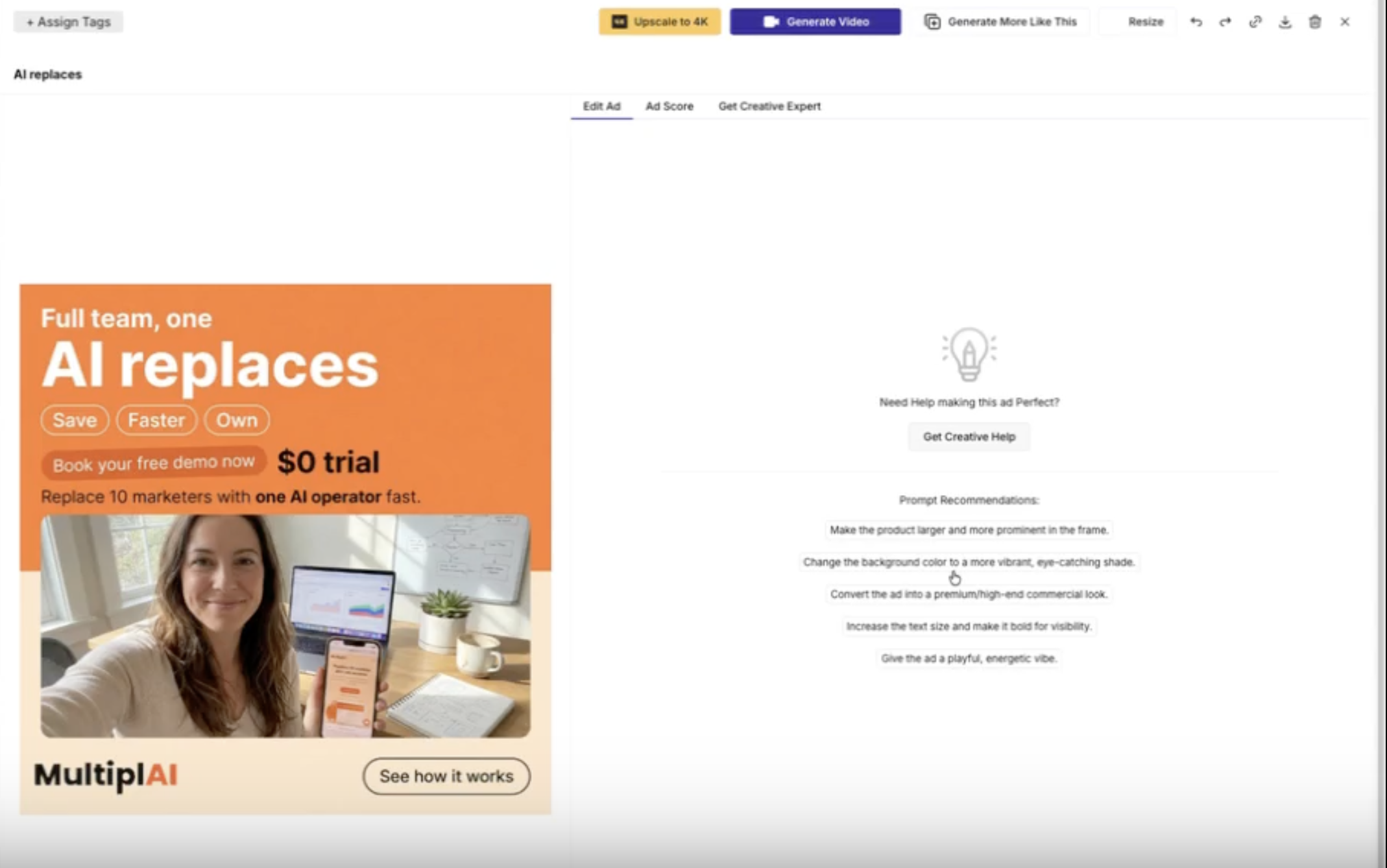
The generated ads are surprisingly decent. When I tested it for MultiplAI Growth, the static ad concepts it produced were genuinely usable starting points. Not “run these tomorrow” ready, but the layouts, color choices, and general messaging were in the right neighborhood. For a marketer who knows what good looks like, that’s a meaningful head start.
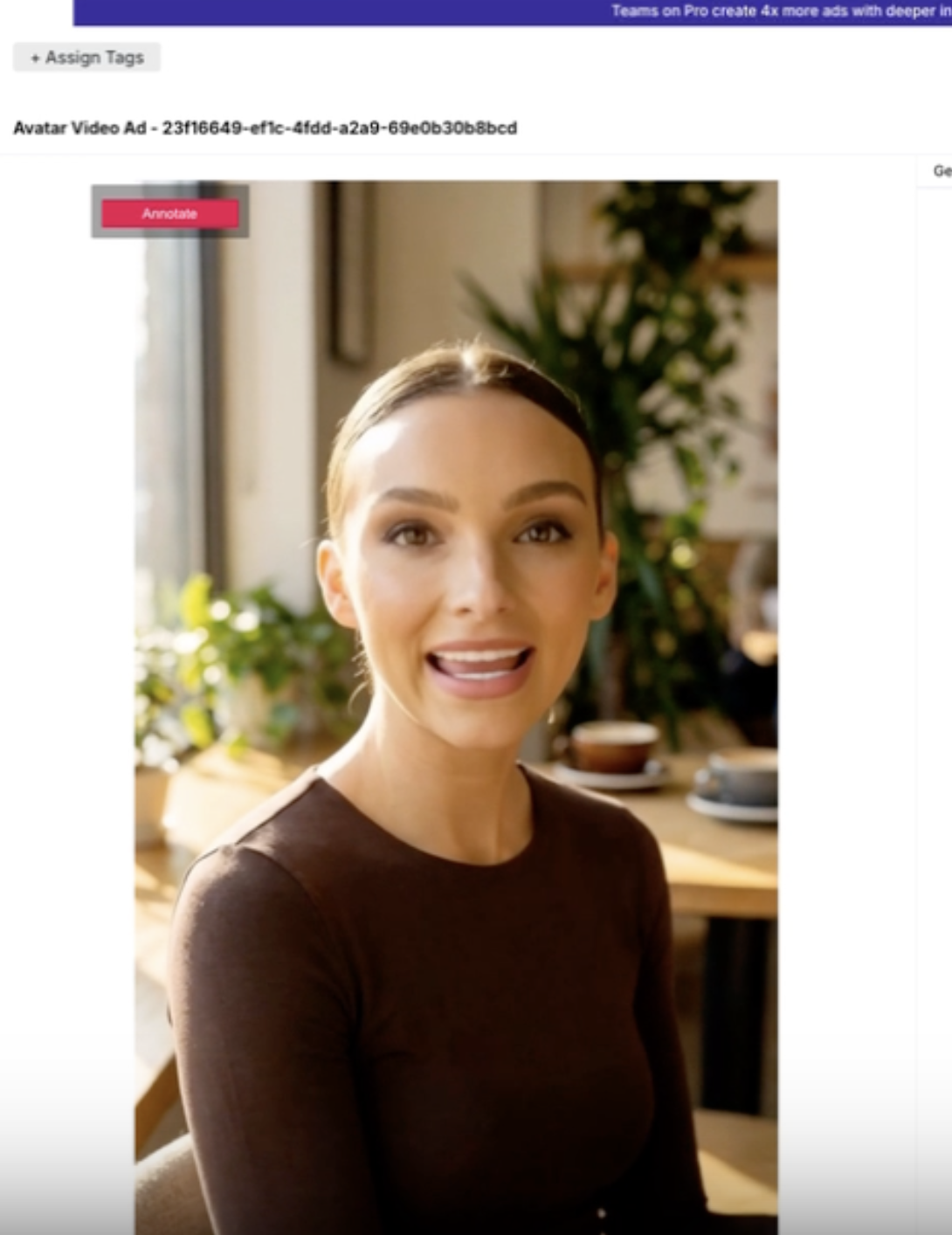
AI avatar video ads are a nice bonus. Omneky offers AI-generated video ads with virtual avatars, and the fact that this lives inside the same tool as your static creative generation is convenient. The avatar quality is still a bit uncanny valley (pretty creepy, honestly), but the technology is moving fast and having it integrated rather than bolted on matters.
Performance-driven creative iteration is the real value. Where Omneky starts to differentiate itself is when you connect your ad accounts. The platform can pull top-performing creatives, analyze what’s working across your account and similar accounts, and then auto-generate new variation ideas. This insight-to-creative loop is where the tool shines brightest, and it’s something most competitors either don’t offer or don’t do as well.

Volume is there. If what you need is 20 or 30 starting-point concepts to react to, Omneky delivers. It generated a full batch of variations for me quickly, across multiple formats and angles. For brainstorming and creative exploration, the quantity is a genuine advantage.
What I Disliked
The UI is chaotic. There’s no polite way to say this. The interface is overwhelming, especially for a first-time user. Navigation is cluttered, and it takes longer than it should to find what you need. For a tool that’s supposed to save time, UI friction is an unforced error.
The “last mile” problem is real. This is my biggest issue, and it applies to almost every AI ad creation tool I’ve tested. You generate ads, you like some of them, and then you need to change one headline or swap a CTA. But the output is a flat image file. You can’t click into a text layer and change a word. You’re stuck either re-prompting the AI (which introduces new problems) or rebuilding the ad manually in Figma or Canva. Every time I got to this point, my momentum died. The gap between “almost right” and “actually right” shouldn’t be this painful.
Copy quality is hit or miss. The AI-generated ad copy often reads like AI-generated ad copy. It’s grammatically correct but not human. It lacks the sharp, specific language that makes ads convert. You can probably improve this with better inputs, and that doesn’t worry me much because copy is easy enough to rewrite. But if you’re hoping to skip the copy-editing step entirely, reset that expectation.
The avatar videos are not ready for prime time. I mentioned them as a pro because the integration is smart. But the actual output? Still creepy. The lip sync, the facial expressions, the uncanny-valley delivery. I wouldn’t put these in front of a paying customer today. It’s a “watch this space” feature, not a “use this now” feature.
Frustrating editing experience. If you want to tweak an ad Omneky generated, you have a few options: use their built-in editing (limited), pay someone to make the changes (they offer this), or re-create the ad from scratch elsewhere. None of these are great. The workflow I want, where I take an AI-generated concept and refine it in layered, editable components, simply isn’t there yet.
Better Alternatives to Consider
No single tool solves this problem perfectly today, but here’s what I’d look at depending on your use case:
The layered approach (my recommendation): What I’ve found works best is using these tools for inspiration and then building in a layered system. Start with performance insights (what’s winning). Draft your copy separately in bulk with a tailored ChatGPT prompt. Generate background images and design elements using AI in bulk using something like Gamma. Then assemble everything in Canva, Figma, or Pencil.ai where each element is an editable layer. It takes a little longer upfront, but it scales better and doesn’t leave you stuck when something needs a small edit.
Creatify — If short-form video ads are your priority (TikTok, Reels, Shorts), Creatify is currently ahead. It turns a product URL into video drafts, offers 1,000+ AI avatars with better quality than Omneky’s, and generates UGC-style video variations in one click. Starts at $49/month.
AdCreative.ai — For fast static ad and copy generation with tight Google and Meta integration, AdCreative.ai is more affordable ($39/month) and more focused. It won’t give you the performance-insights loop that Omneky offers, but if you just need creative volume quickly, it gets the job done.
Canva — Still the most practical tool for the “last mile” problem. Canva’s AI features keep improving, and the layered, component-based editing means you can actually tweak things without starting over. Use AI tools for ideation, then bring it into Canva for final production.
What to do
If navigating these tools, building these workflows, and figuring out which AI actually plugs into your marketing feels like a lot, let’s chat. I advise growth leaders and marketing agencies that are transitioning into the post-AI marketing world in my practice, MultiplAI Growth Systems.
We also put this guide and prompt pack together for you. Use it to replicate our process, mentioned above and let us know how you liked it!
Have you tried Omneky or any of the other AI ad tools? Which ones are you using in your workflow right now? I’m testing a new one every few weeks, and I’d love to hear what’s actually working for you.