AirOps Review — A $3,000/Month LLM Wrapper That Might Be Exactly What Your Team Needs

Why I'm reviewing this
I want to be upfront about why my perspective on AirOps might be different from the other reviews you've read online.
Content marketing is the space where I have the deepest expertise out of fifteen years of growth and marketing work. I started in B2B SaaS in 2012, when lifecycle marketing and tools like HubSpot were just taking off. Since then, I've run content operations at a scale that most reviewers haven't touched. At Healthline Media Group, I worked with a 300-person editorial team across five websites, developing strategy for roughly 2,000 to 2,500 pieces of content a month across five or six formats, all running through a WordPress-centric production process. At People Inc. (formerly Dot Dash Meredith, formerly Meredith), I worked with a 400-person content organization and a 15-person growth team across more than 30 domains, including printed magazines in every supermarket aisle in the country and a mail-order subscription business. We were producing 3,000 to 4,000 content pieces a month and doing four to five times as many content updates as new publishes, optimizing for visibility and engagement across ten to twelve distribution platforms simultaneously.
I've also spent years on the other side of the content equation, running demand gen for healthcare, fintech, and DTC businesses selling complex products in highly considered purchase journeys: UnitedHealth Group, American Express, Noom, and intensive behavioral health startups. Today I work predominantly with growth-stage startups, bringing what I learned from the businesses that do this better than anyone in the world and applying it to teams that don't have a $10 million martech budget.
That's the lens I'm evaluating AirOps through. Not "is this a cool AI tool" but "does this actually improve how content production works at a level I'd consider professional?"
I've been hands-on with AirOps for three months.
Bottom line up front
Conditional recommend.
AirOps is a super expensive LLM wrapper specifically designed for marketing teams that produce a lot of content. Whether it's a good fit depends on two things: what type of team you want to build around AI, and what your budget is.
I'm seeing two types of teams emerge right now, and which one you're building determines whether AirOps makes sense.
The builder team wants to democratize AI access across the organization. They encourage their people to learn how to use LLMs in their native habitat. They set up GitHub repos for the team to work in, create context files and skills that get distributed through shared repos, and merge PRs as the system evolves. Their growth leaders are technical. They might hire someone into a dedicated "vibe coding" role, the way Lovable recently hired a non-technical marketer whose entire job is building internal tools and customer-facing utilities using AI coding tools, then releasing them to the team with simple training. These teams are generally smaller, more technical, and more comfortable with an IDE-first workflow. For them, AirOps feels like a huge waste of money compared to what they could build over a weekend in Cursor or Claude Code.
The platform team doesn't want to teach everyone how to prompt engineer or build their own workflows. Maybe they're a large operation with dozens of content producers. They have the budget for expensive tooling. What matters to them is hiring one GTM engineer or growth engineer to manage the platform, build the workflows, and let the rest of the team consume the output without needing to understand how LLMs work, how to structure context, or how to improve their prompting. For them, AirOps is a phenomenal value because it eliminates the need to build everything from scratch and provides the guardrails that let non-technical team members produce quality work.
I'm not saying either approach is fundamentally better. They're different, and both are viable. But knowing which team you're building is the first question to answer before evaluating AirOps.
How this work is actually done
Before I get into what AirOps does well and where it falls short, I want to explain how content production actually works at a professional level. This matters because most AirOps reviews evaluate it as an "AI writing tool." It's not. It's a content production workflow platform, and you can only evaluate it properly if you understand the workflow it's trying to automate.
Professional content production runs through four phases that most people collapse into one.
- Customer and content strategy: who are your readers, what do they need, what are their problems and goals, and where do they consume this type of information?
- Competitive differentiation: who else is creating content for these readers, how are they approaching it, and how do you do something different and better?
- Distribution strategy: how do you actually get your content seen in the channels where your readers already are, and how do you optimize for discoverability, engagement, and return visitation in each channel?
- Production: now that you know what you're making, for whom, and how it will be distributed, how do you actually produce it at scale?
Most AI content tools, including AirOps, live primarily in phase four. That's not a criticism unique to AirOps. It's an observation about where the entire category sits. The strategic work upstream still needs to happen before any production tool can do its job well. If your content strategy is weak, AirOps will just help you produce weak content faster.
The production phase itself typically runs through something like:
- a content brief (with inputs from SEO, editorial, and distribution teams), followed by
- research and drafting
- editorial review for brand and tone compliance
- distribution optimization (metadata, schema, headings, FAQs, structured data)
- CMS production and merchandising, analytics hookup, approval, and
- publish.
At enterprise scale, this involves specialized roles at each stage and a workflow management system to move pieces through the pipeline.
Historically, teams have managed this in Google Sheets, Notion boards, or most commonly, Airtable. Airtable became the natural evolution because it lets you automate stage transitions, inject information at each step through integrations, trigger notifications when a piece needs input from a specific team, and tag content for performance tracking. It functions as the connective tissue between the strategy, editorial, distribution, and production teams.
AirOps is essentially trying to be Airtable for AI-powered content production. Understanding that comparison is the key to understanding whether it's worth $3,000 a month.
What AirOps gets right
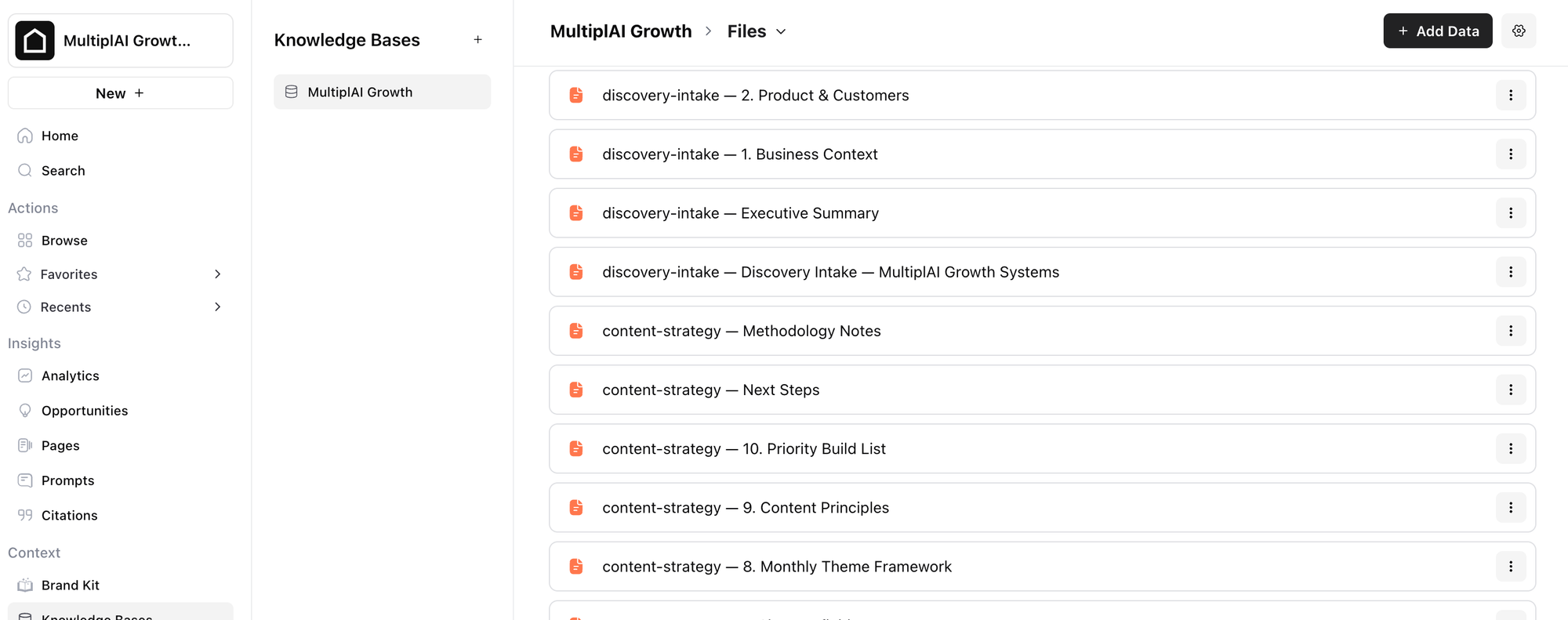
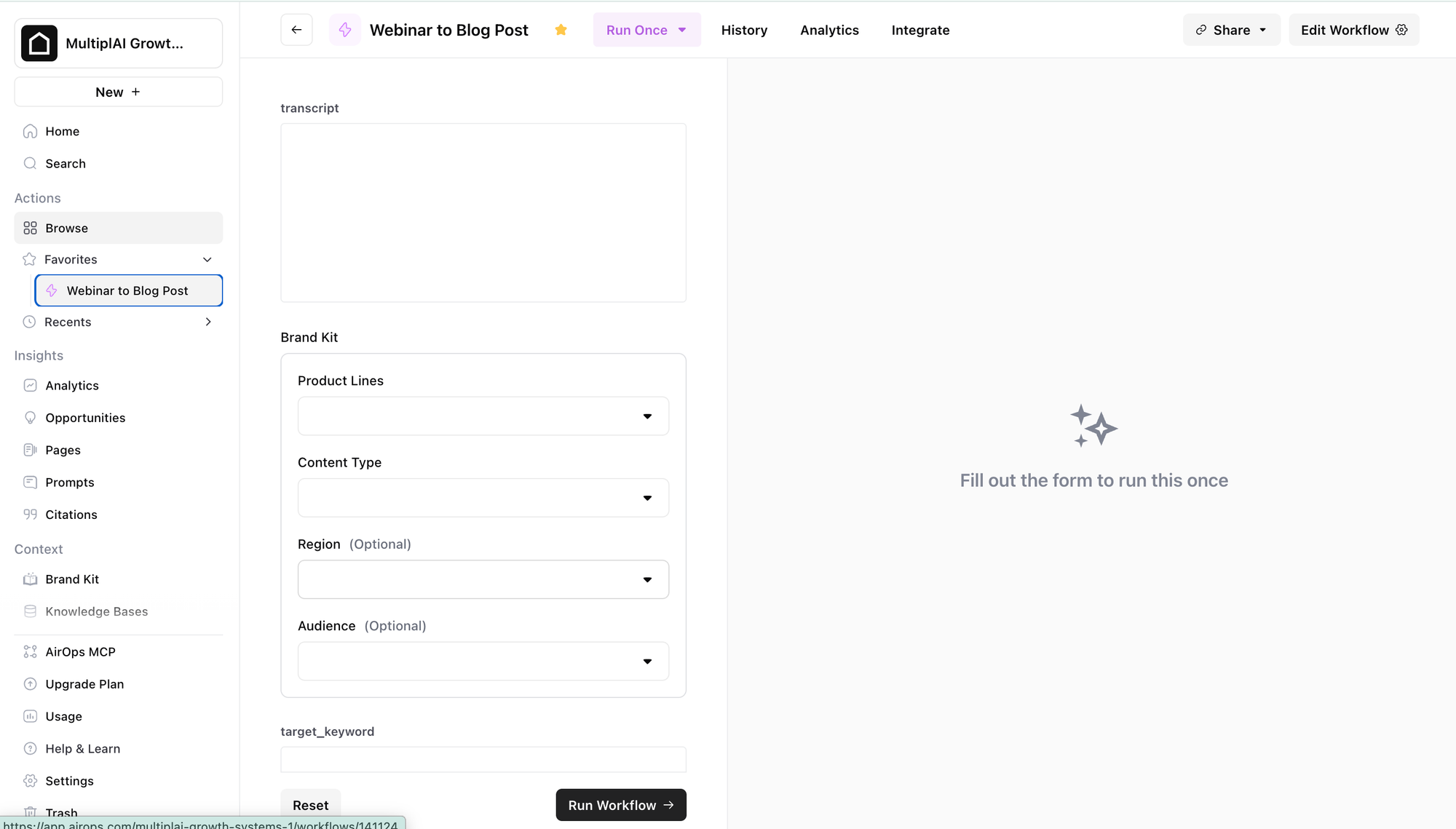
The strongest thing AirOps does is solve the context problem that makes most AI-generated content terrible. Its Brand Kit and Knowledge Base system forces users to give the models the right context, in the right amount, in the right structure. This matters more than most people realize. The gap between a raw ChatGPT prompt and a well-contextualized workflow with brand voice, product line details, audience definitions, and content type specifications is enormous. AirOps closes that gap for teams that don't know how to do it themselves.
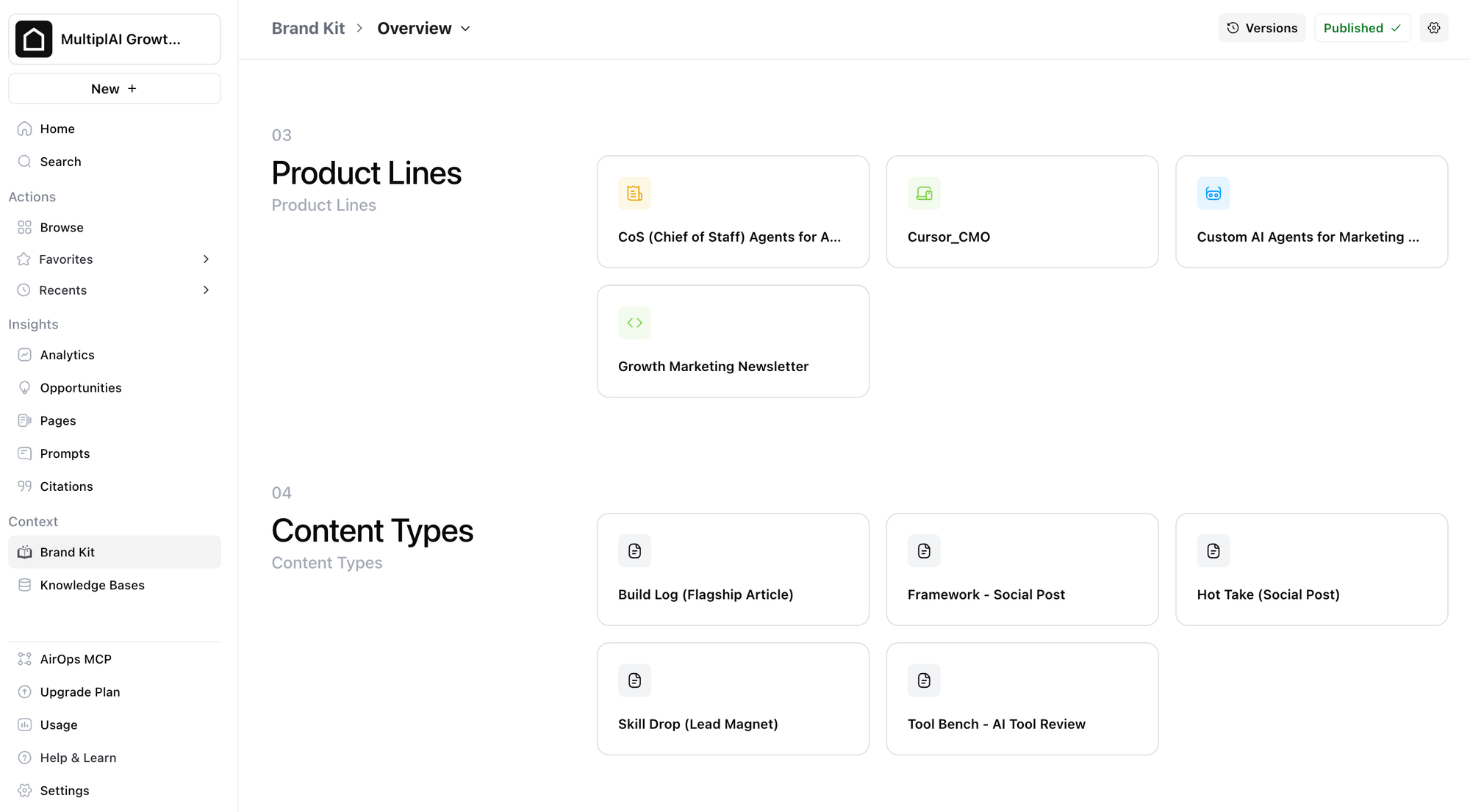
The Brand Kit specifically includes brand foundations (what you sell, to whom, against whom), tone and voice guidelines, product lines (so you can write about different products with accuracy), content types (for different formats and templates in your portfolio), audiences (so you speak to each user type effectively), regional variations, visual guidelines and logos for image creation, and custom variables. This is legitimately better than Jasper's approach to the same problem– but Jasper costs 50 to 70 percent less per month than AirOps.
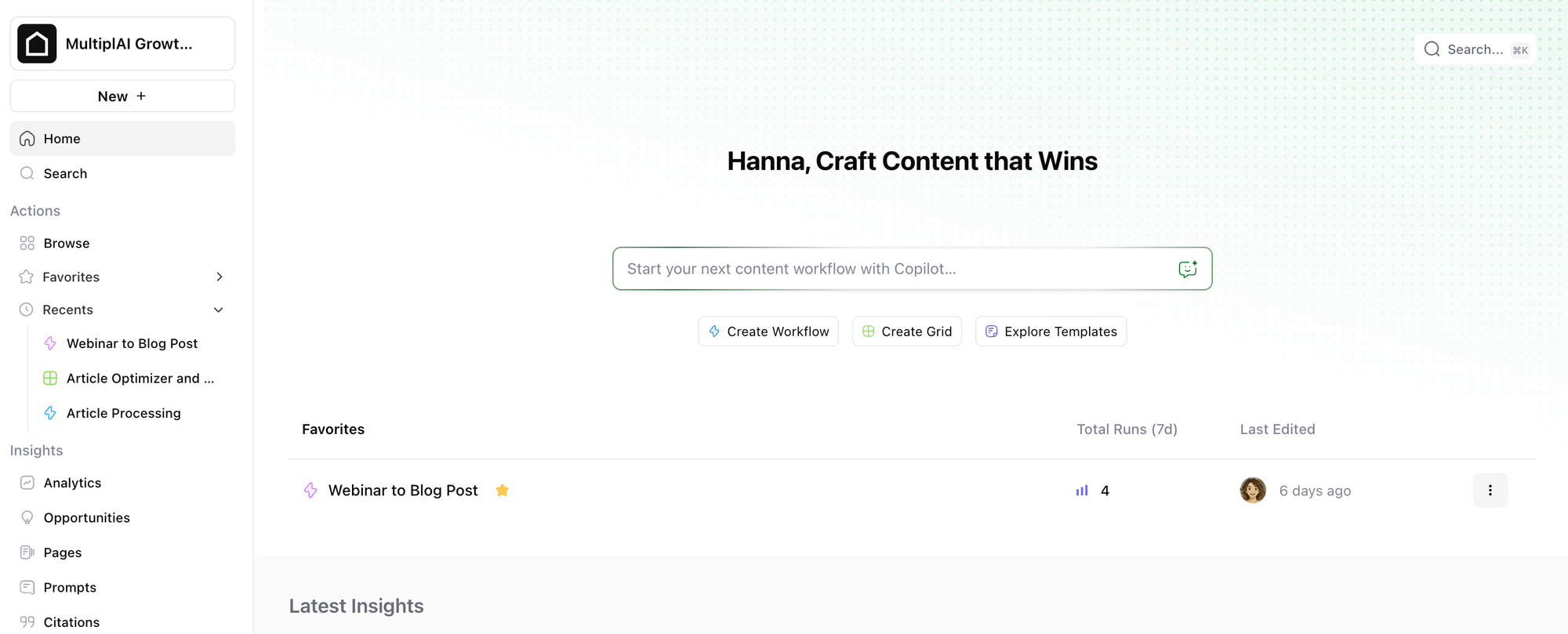
The drag-and-drop workflow editor feels familiar to GTM operators who've built workflows in Braze, Iterable, n8n, or Zapier. The Grid processing interface feels familiar to anyone who's worked in Airtable or managed content production in Notion or Google Sheets. I really like how the grids process work from left to right across columns, where columns are powered by automations and LLM work that essentially enriches and "creates" a final output to the right of the original souce– whether that source is a keyword target or an initially content draft or brief. It's super powerful because it's very flexible. But that also feeds into the learning curve and "speed to value" challenge. More on that, later.
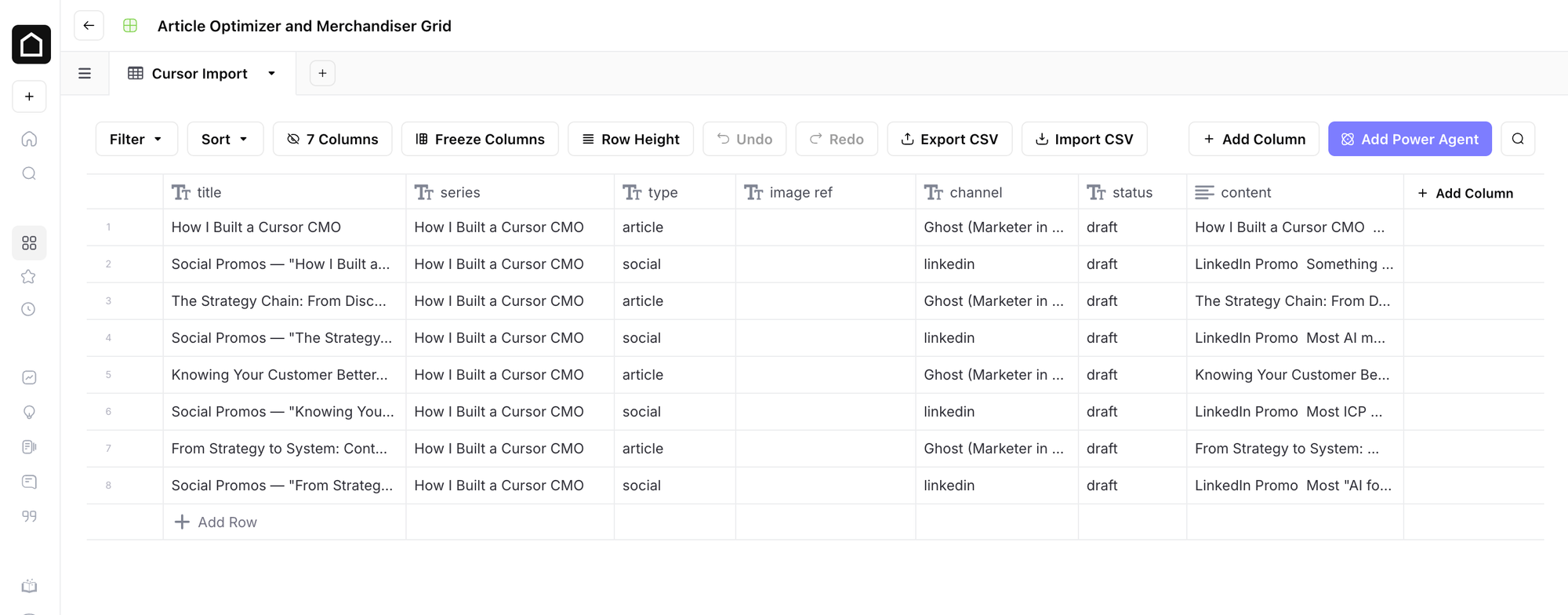
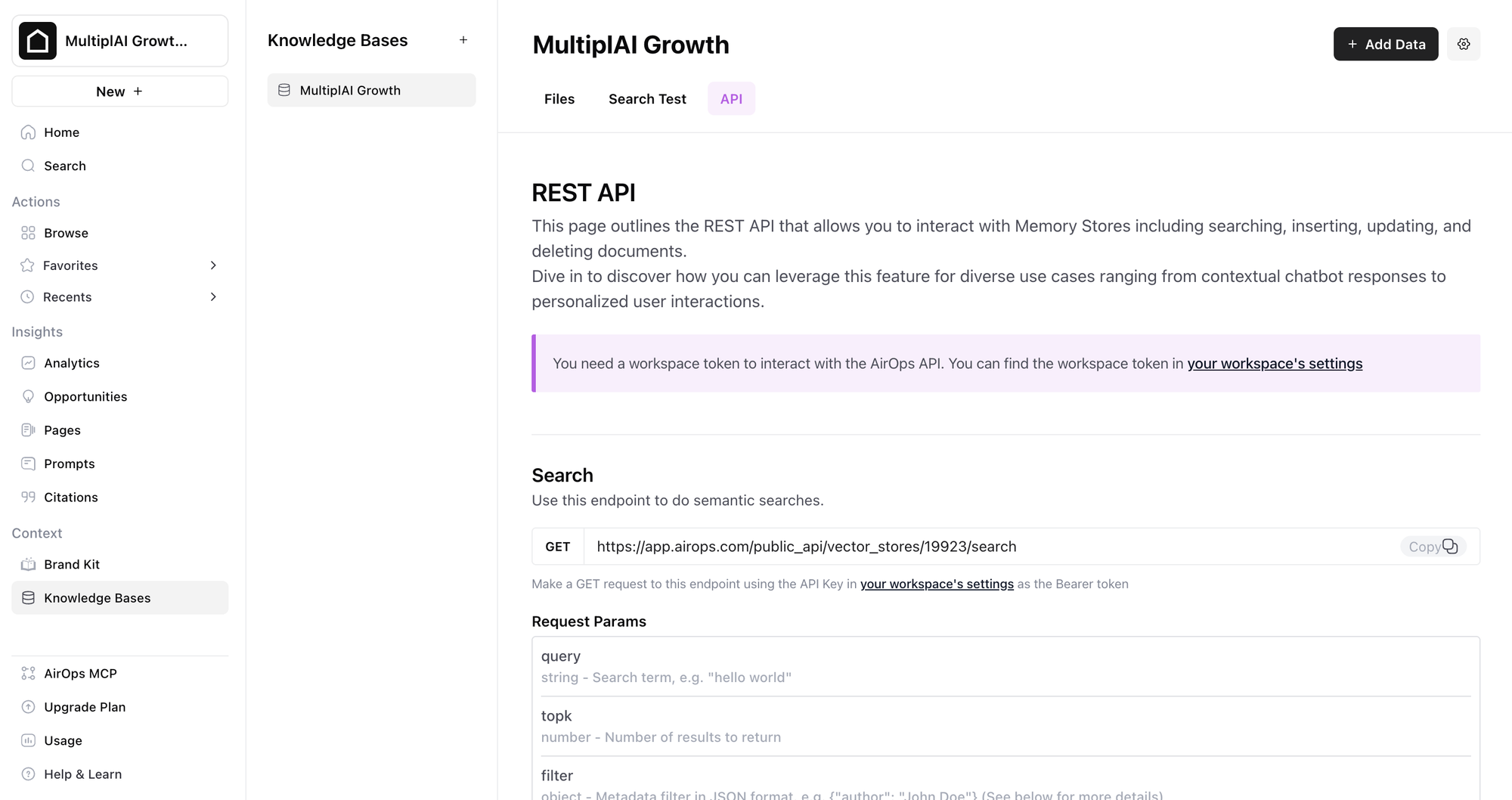
These aren't revolutionary interfaces, but that's the point. They reduce the learning curve for people who already understand workflow-based production systems.
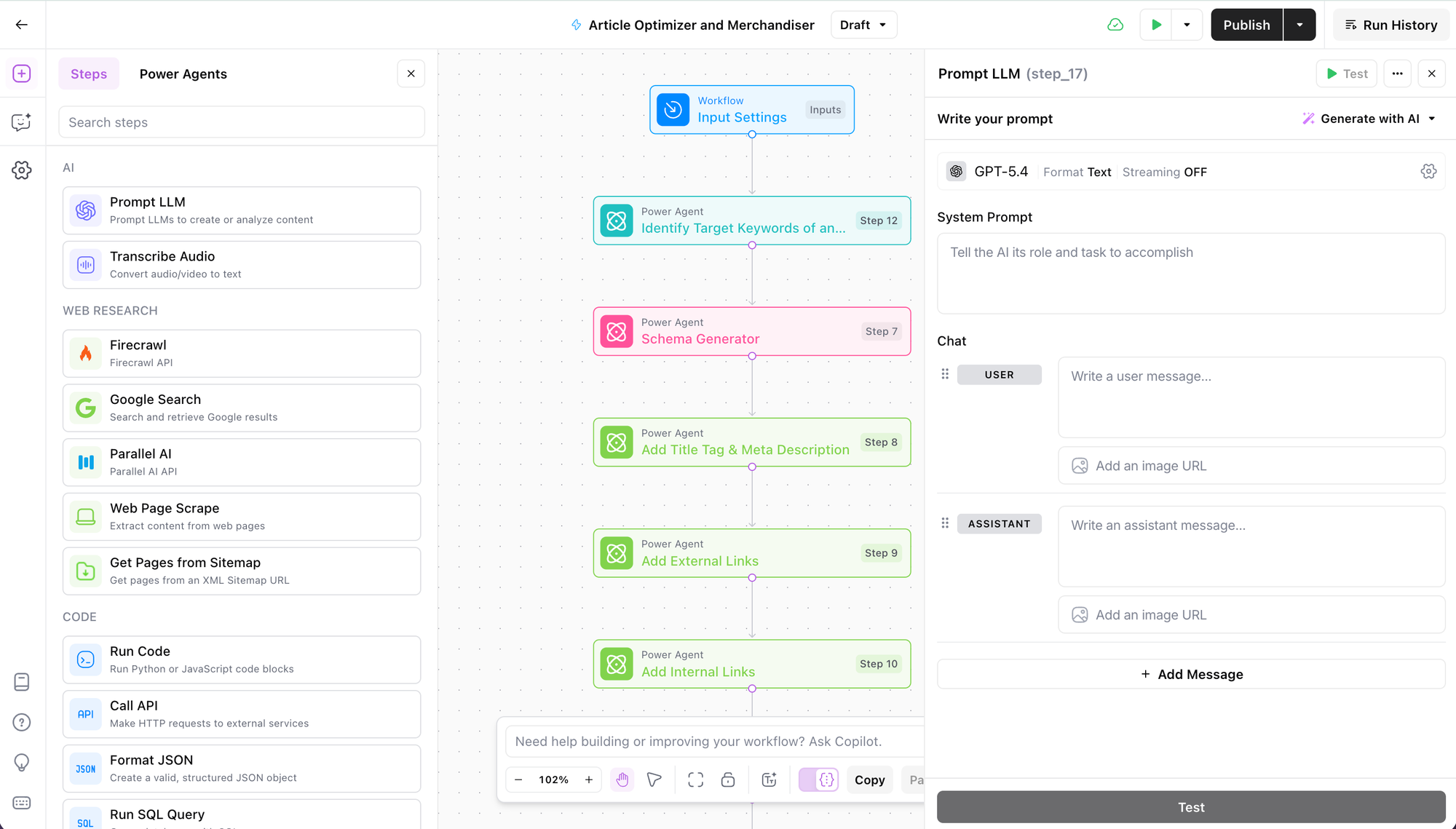
Once you put two to four weeks into learning the tool at its most basic level, the output is genuinely better than what most users would get from raw ChatGPT on the same workflow. The Knowledge Base and Brand Kit do real work in improving output quality, and for large teams where you can't train everyone to be a sophisticated prompt engineer, that's a meaningful advantage.
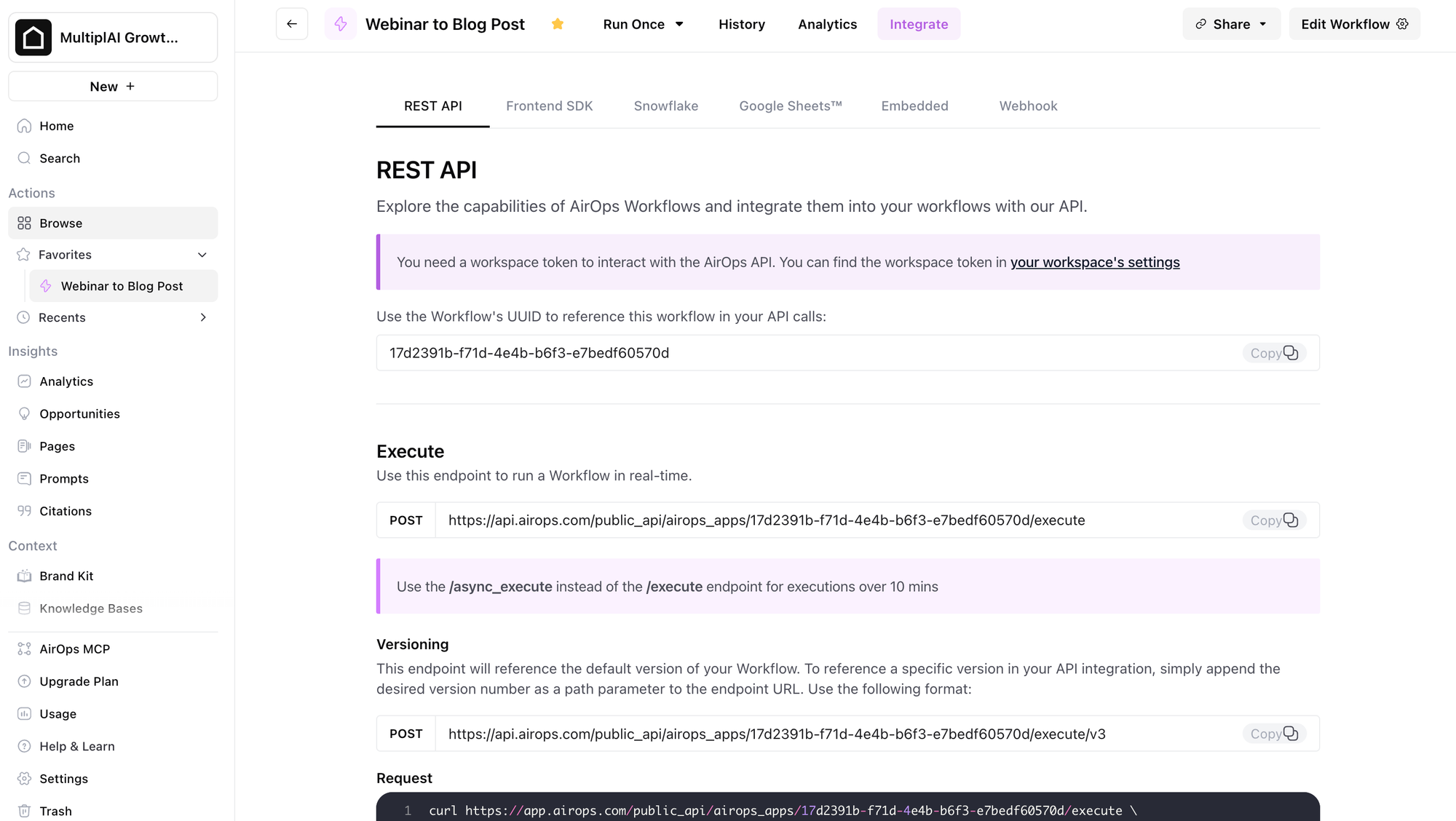
The integrations are strong. Easy to push and pull data from Airtable at each stage of production, pull SEO research from Ahrefs and Semrush, ingest traffic data from Google Search Console, push from Claude Code into AirOps via their MCP, and publish directly to CMS platforms like WordPress and Webflow. The API functionality is excellent: you can run established workflows via REST API, Frontend SDK, Snowflake, Google Sheets, or webhooks.
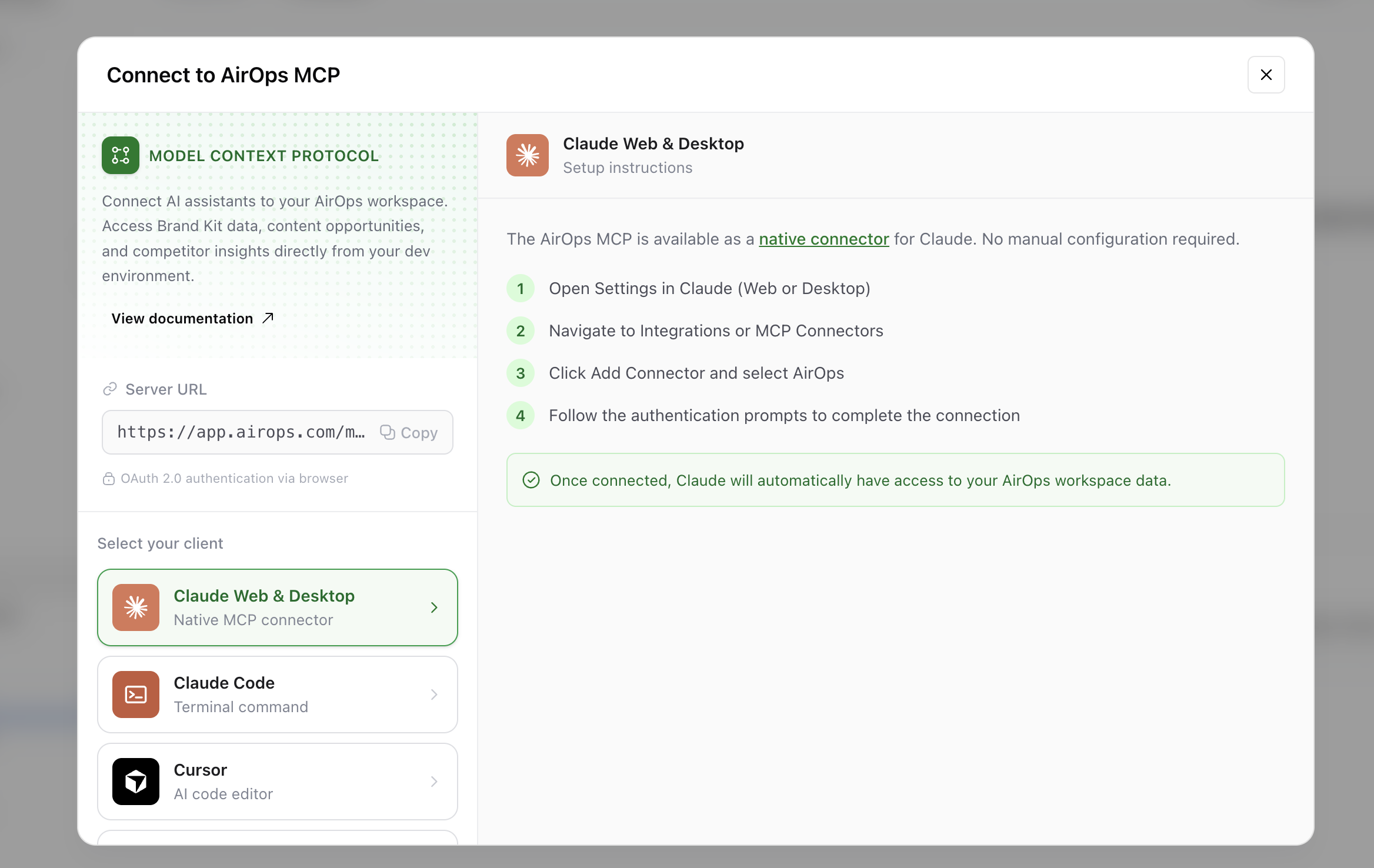
Speaking of the MCP: it's genuinely impressive. Simple to install, feels like a true extension of the LLM and IDE environment, and makes it easy for people who prefer working in Cursor or Cowork to interact with AirOps workflows without leaving their terminal.
The learning resources are robust. Live cohorts, async courses, seminars, and an embedded copilot. Part of this investment in education is necessary because the tool is genuinely hard to learn, but the commitment to helping users get there is real.
And for enterprise teams specifically, workflow sharing is well-designed. A small group of GTM engineers can build and maintain workflows and share them with the rest of the team to use, similar to how a Braze or Iterable implementation might work. You maintain control of how workflows function and evolve over time while making them accessible to less technical team members.
What AirOps gets wrong
It takes a solid one to three months, depending on how much strategy work needs to happen first, to set up the context, standards, processes, and automations in the platform. And that doesn't include the organizational work of changing processes, reorganizing teams and workflows, training people, and getting them comfortable using the system correctly. This is a major transformation, not just a new tool. Think about it similarly to how you might have thought about big digital transformations circa 2020 or big CRM and automation transformations circa 2010. Plan for one to two quarters to get going.
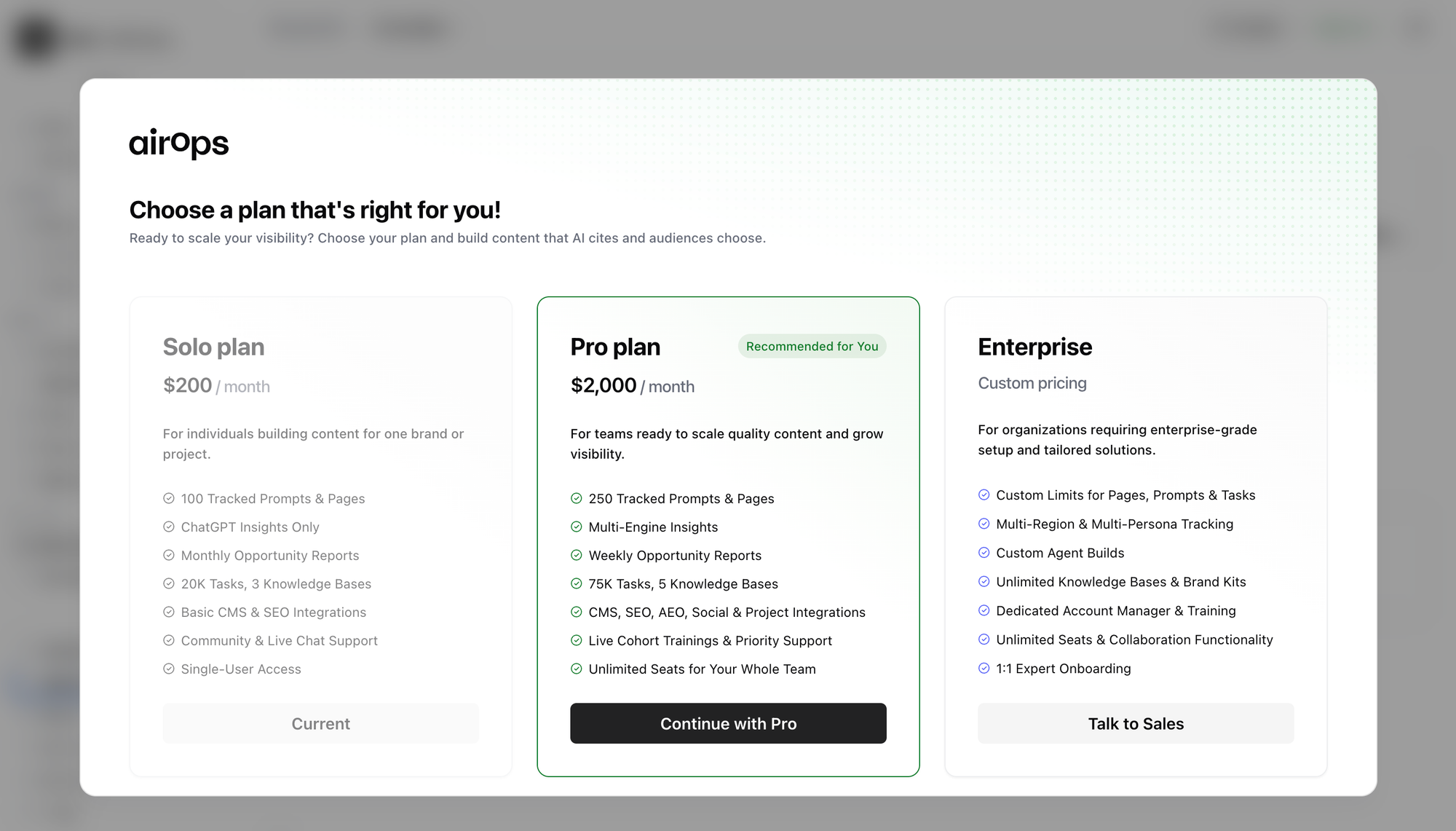
The "built-in" AEO visibility tracking, keyword research, and content optimization features are a real afterthought in the offering. They're extremely expensive to use meaningfully, and the actual functionality is underwhelming. The Solo package at $200 a month limits AEO insight updates to once per month and doesn't support query-level tracking. More sophisticated teams with channel-specific expertise in SEO aren't going to use this, and smaller teams won't get useful data from it without paying double what they'd spend on a dedicated tool like Profound or Ahrefs.
This creates a frustrating dynamic. AirOps markets itself as an all-in-one solution, but in practice you'll still need several thousand dollars a month in additional subscriptions to get the right data into your workflows. You'll still need Profound or Graphite for AEO. Ahrefs for content strategy and traffic optimization. Social publishing tools to manage social distribution. The $3,000 you're paying for AirOps is on top of all of that.
The biggest functional complaint: you still have to build all of the workflows manually. If you're coming from a Claude Code or Cursor environment where you're moving fast, switching to the AirOps workflow and Grid UI feels like hitting a brick wall in a race car. The platform is powerful once configured, but the configuration process is tedious even for technical users who've managed implementations of tools like Braze, Adobe CDP, or Segment.
And the pricing deserves its own paragraph. The Solo plan starts at $200 a month with minimal functionality. The Pro plan is $2,000 a month. Scale and Enterprise plans require a sales call and run $3,000 to $4,000 or more. On top of flat monthly fees, there's a credit-based task billing system where not all workflow steps count equally toward usage, making it nearly impossible to forecast your monthly bill. Overage rates run 20 to 30 percent higher than standard plan rates. Multiple users report credits depleting mid-batch without clear warnings.
The elephant in the room
What AirOps gets compared to has changed dramatically in the last year. A year ago, the comparison was AirOps vs. Jasper vs. other AI content platforms. Today, an increasing number of teams are comparing AirOps to building their own systems using Claude Code, Cursor, Codex, or Gumloop.
If you have one strong engineer and a non-technical head of marketing who knows what a good content production system should do and why, you can build your own system with Claude Code in a couple of weeks. It will do exactly what you need, exactly the way your company does it, for your specific users and business. And it won't cost $3,000 to $5,000 a month.
That sounds provocative, but it's the reality of where the tooling landscape is in 2026. The question is whether your team has the capability to build and maintain that kind of system. Most don't.
If you've spent time in paid search, you'll recognize this dynamic. AirOps feels to me the way Kenshoo and Marin feel in paid media management. If you know how paid search auctions actually work, how to maximize the features built into native Google Ads, and how to harness and activate all of the data available within those native systems, then you don't need Kenshoo. You just know what to do and how to do it, and you'll get better performance out of the native platform than you would with an expensive abstraction layer on top. But if you have an unsophisticated operator running paid search who doesn't know all of that, then something like Kenshoo lets them run Google Ads in a somewhat effective way that clients would pay money for.
That's the same way I feel about AirOps, except AirOps is actually pretty hard to use. It's not cleanly on either side of that cost-benefit equation right now unless you're a large team that already has a marketing ops or GTM engineering group managing Airtable workflows or n8n workflows or Iterable or Braze or Segment logic. If you already have that operational muscle, AirOps makes a ton of sense because it maps to skills your team already has. If you don't, you're going to be really surprised at how much it actually costs to run AirOps in your organization compared to just hiring more sophisticated, more experienced growth marketing people who don't need an expensive tool to tell them what to do and how to do it.
And that's the honest case for AirOps for the teams where it does work. It's an easier way to teach large enterprise teams how to use LLMs for marketing and content production than saying "go learn Claude Code and build everything yourself." That will take most people one to two years, and the results won't be good while they're learning. AirOps compresses that learning curve into something a platform team can adopt with one GTM engineer leading the implementation.
But here's what I think is critical and most reviews miss: this is not a new tool you're going to buy and onboard in a month or two. This is a six-to-nine month transformation. It feels very similar to what happened with HubSpot in the early 2010s. Moving into HubSpot meant transforming your entire digital marketing operation. You had to set up the platform with all of your data, build your templates, migrate your contacts, develop workflows and sequences and triggers, train your teams on entirely new processes. That took six to twelve months. AirOps requires the same type of organizational commitment.
I wouldn't be surprised if AirOps starts building a partner and affiliate ecosystem similar to what HubSpot did back then. HubSpot's early growth was largely powered by agencies that knew the platform well enough to get it into more businesses, because the learning curve was too steep for most companies to adopt on their own. AirOps faces the same dynamic. The number one barrier to adoption isn't whether the tool works. It's that nobody at the business knows how to do this type of work yet, and hiring someone who does is extremely difficult right now. A whole field of "content engineers" or "GTM engineers" is going to emerge around this, the same way "HubSpot specialists" became a job category a decade ago.
Alternatives to consider
For sophisticated builders: Build your own system with Claude Code, Cursor, or Codex. Seriously. If you know what you're doing, you'll get a better system, customized to your exact workflow, for the cost of your LLM API usage. This is what I do, and it's what I teach in the Marketer in the Loop Skills MCP.
For content production specifically: Copy.ai has evolved beyond content generation into a full GTM automation platform that bridges sales and marketing workflows. Writer is the enterprise-grade option for organizations that need strict brand and compliance guardrails across large teams. Both produce strong first-draft content at a lower price point than AirOps and are purpose-built for the writing portion of the workflow.
For workflow automation and production management: n8n is open-source, self-hostable, and infinitely flexible. It doesn't have AirOps' content-specific features out of the box, but if your team can code, you can build anything AirOps does and more. Pair it with Airtable for the production tracking layer (stage management, tagging, team notifications, status automation) and you have a content production system that matches most of what AirOps offers for a fraction of the cost. This is the combination I've seen the most sophisticated content teams run before AirOps existed, and it still holds up.
For budget-conscious teams: Metaflow AI starts at $19 a month and handles visual workflow building, keyword research, and bulk publishing with support for non-content workflows. ContentMonk requires only 15 to 30 minutes of editing per article versus 2 to 3 hours with AirOps.
For AI search visibility specifically: Profound, Graphite, or the Semrush AI Visibility Toolkit at $99 a month will give you better AEO analytics than AirOps' built-in offering.
The bottom line
AirOps is a genuinely capable content production workflow platform that solves real problems for enterprise teams scaling AI-powered content operations. The Brand Kit and Knowledge Base are best-in-class. The integrations and API are excellent. The MCP is impressive. The learning resources show real commitment to user success.
But it's priced for enterprise teams ($2,000 to $4,000+ per month), requires one to two quarters of setup and organizational change management before delivering value, doesn't replace the specialized tools you already need for SEO, AEO, and social distribution, and feels like a step backward for anyone who's already comfortable building in an IDE.
The honest question isn't "is AirOps good?" It is. The question is which type of team you're building. If you're building a platform team and you have the budget and the patience for a six-to-nine month transformation, AirOps might be worth every dollar. If you're building a builder team that wants to learn AI natively and construct their own systems, you'll get more value from Claude Code, a shared GitHub repo, and a growth engineer who knows how to set it up. Both paths lead to AI-powered content production at scale. They just get there very differently.
This review is part of the Marketer in the Loop Tool Bench series. Every week I test one AI marketing tool in real workflows and give you the honest assessment. The full resource library is available on the Marketer in the Loop site.
About Marketer in the Loop
Marketer in the Loop shows how an AI-native marketing practice gets built: what worked, what broke, and what you can use in your own system. It is published by MultiplAI Growth Partners, which helps agencies and marketing teams turn scattered AI experiments into working systems.
Build it yourself with MITL Pro
MITL Pro includes the MITL MCP, every current and future suite, downloadable templates, prompt packs, practical frameworks, the full Pro archive, and a 20-minute call with Hanna. Install one connector in Claude Code or another MCP-compatible client, then use the system from the tools you already work in.
Want a roadmap built around your business?
The Agentic Consult is a free, on-demand 8–10 minute conversation with an AI operating advisor. It asks what result you want, what you’ve tried, what worked, what didn’t, and what is blocking you. Hanna reviews the output, and your personalized roadmap arrives by email within an hour—with a clear diagnosis, three prioritized systems, an implementation sequence, and a measurement plan.
Free. No calendar booking required.