It's Hot. It's Ready. But Is It Good?
Why AI-Powered Volume Is the Biggest Trap in Marketing Right Now
My brother-in-law has this joke about Little Caesars pizza. You know the tagline: “Hot-N-Ready.” His version adds a third question that the branding conveniently leaves out. “It’s hot. It’s ready. But… is it good?”
I’ve been thinking about that joke a lot lately, except now it’s about marketing.
Every week I see another post on X or YouTube from someone showing off their “AI marketing hack.” They produced 50 LinkedIn posts in an hour. They generated 200 email subject lines in ten minutes. They published a full blog a day for a month using nothing but Claude and a content brief template. The comment sections are full of fire emojis and “this changes everything” energy.
And all I can think is: it’s hot. It’s ready. But is it good?
There’s a Jurassic Park quote that keeps coming back to me. You know the one. Jeff Goldblum sitting across the table from the guy who built a theme park full of dinosaurs, saying, “You spent so much time thinking about whether or not you could that you didn’t stop to think about whether you should.” That’s where we are right now in AI-powered marketing. We’ve proven we can produce at insane scale. We haven’t stopped long enough to ask whether we should.
Because here’s the thing that most of these “look how much I can produce” threads don’t address: just because you can make all of that stuff so easily and so quickly doesn’t mean it’s going to drive a business outcome. Doesn’t mean it’s going to generate leads, or increase subscribers, or convert to sales. Doesn’t mean anyone is going to read it, watch it, click it, or care about it at all. Production is not performance. Output is not outcome.
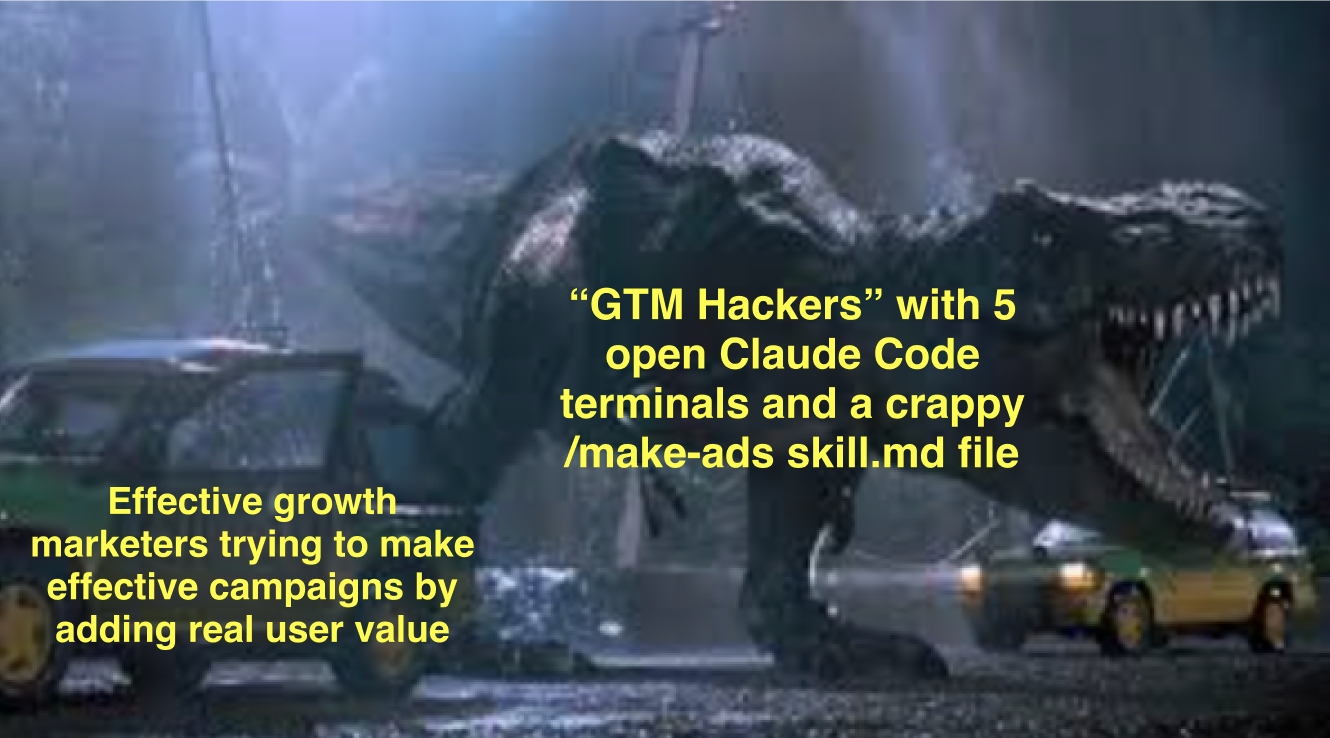
And the math is about to get a lot worse.
The most crowded market you’ve ever seen
Right now, early adopters are getting a temporary edge from AI-powered content production. They’re publishing more, faster, and in some cases the quality is genuinely decent. The problem is that this advantage has an expiration date, and it’s approaching fast.
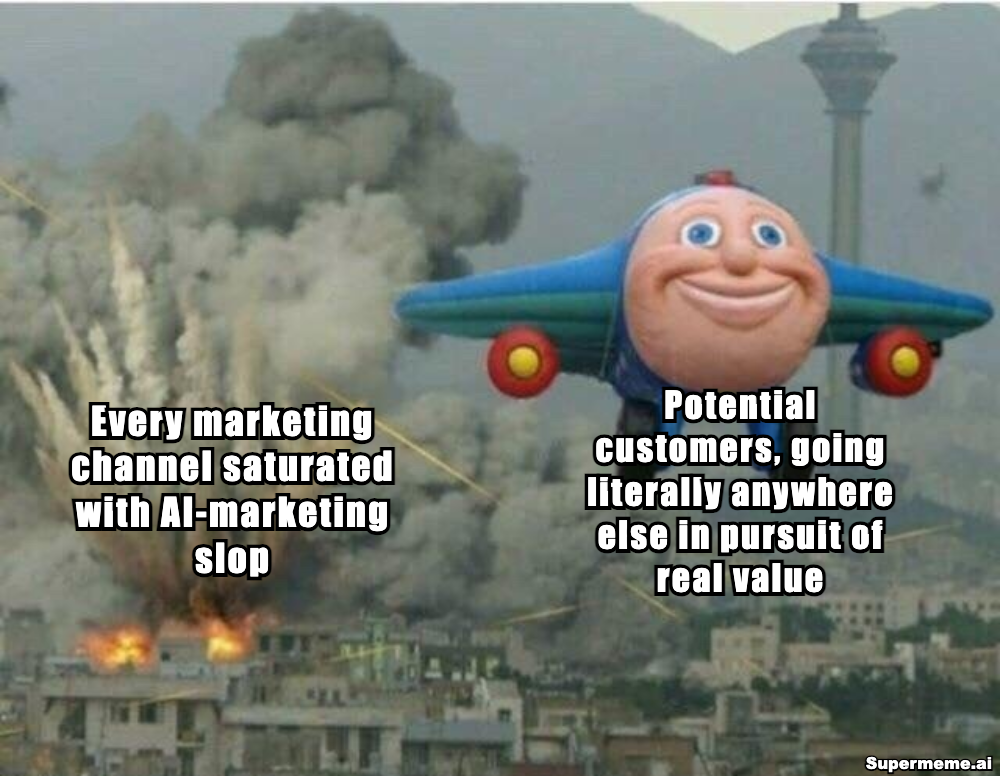
When everyone has access to the same tools and the same workflows, everyone will produce at the same scale. And they will. Brand Communicator projects that 1 billion AI-generated videos alone will flood platforms in 2026. That’s just video. Add in blog posts, social content, email campaigns, ad creative, lead magnets, and landing pages, and you start to see the shape of what’s coming: a tidal wave of content that all looks, sounds, and reads like everything else on the internet.
The data is already showing the backlash. Digiday reported that consumer preference for AI-generated content dropped from 60% in 2023 to just 26% today. People can feel the difference. They’re getting the drive-thru experience when they want fine dining, and they’re starting to tune out. Meanwhile, 71% of marketers say engagement is harder than ever, according to TopRank Marketing’s 2026 thought leadership report. The flood hasn’t even fully arrived and the water is already rising.
If you have a problem right now with spend efficiency, conversion quality, or even traffic levels on the platforms you’re operating in, that challenge is about to multiply. There’s going to be more competition than ever. More content than ever. More ads than ever. CPMs will keep climbing. The only way you can win is if you have something that everyone else producing at volume doesn’t: a strategy for why you’re producing what you’re producing, for whom, and in service of what.
Which brings me to a framework I keep coming back to.
Barrels and ammo
A mentor of mine once described the people on a team as either “barrels” or “ammo.” The idea originally comes from Keith Rabois, the PayPal and Square executive, who used it to explain why adding more people to a company doesn’t always make it faster. His point was that most talented people are ammunition. They can do excellent work when pointed in the right direction. But what companies actually need more of are barrels, the people who know where to aim, who can take something from idea to completion, who understand which 20% of the work generates 80% of the impact.
I think this framework maps perfectly onto what’s happening in marketing right now.
AI has given every team unlimited ammunition. You can produce hundreds of campaign assets on any given day. If you’re any good at prompting and you provide the right context, the output can even look pretty solid. The production bottleneck that used to define marketing capacity has been largely removed.
But here’s the question nobody is asking loudly enough: do you have barrels?
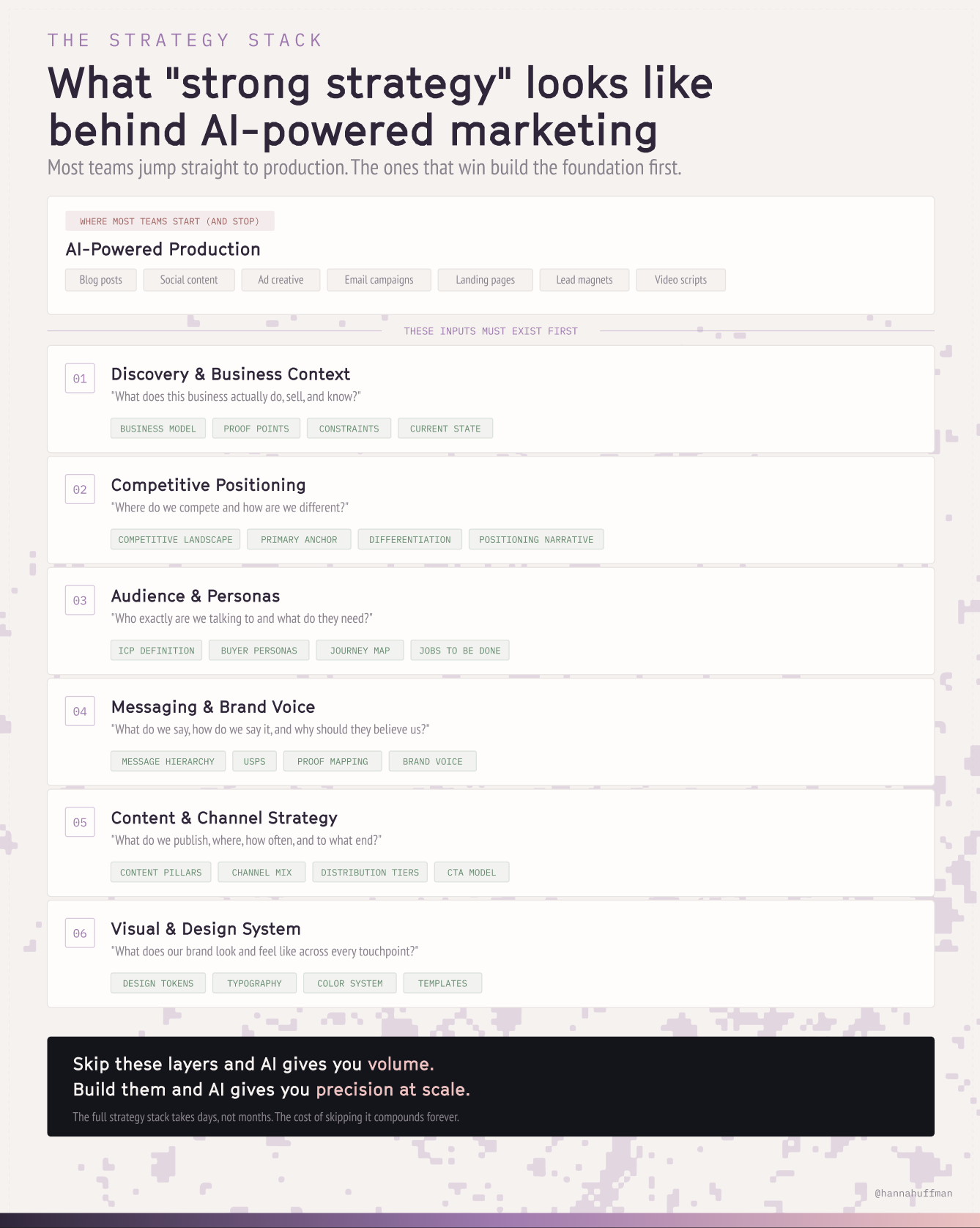
Do you have a really clear strategy around which customer profiles you should actually be targeting? Have you done the positioning work to understand where you compete and where you don’t, so you can fight fewer battles and win more of them? Do you know which channels your ideal customers are actually in, not just which channels are popular? Is your messaging built on real user research, or are you just rephrasing what your competitors say on their websites?
Because if you don’t have those barrels, you’re just pointing unlimited ammunition in every direction and hoping something hits. And in a market that’s about to be 20 times more crowded than it was a year ago, spray and pray isn’t a strategy. It’s an expensive way to contribute to the noise.
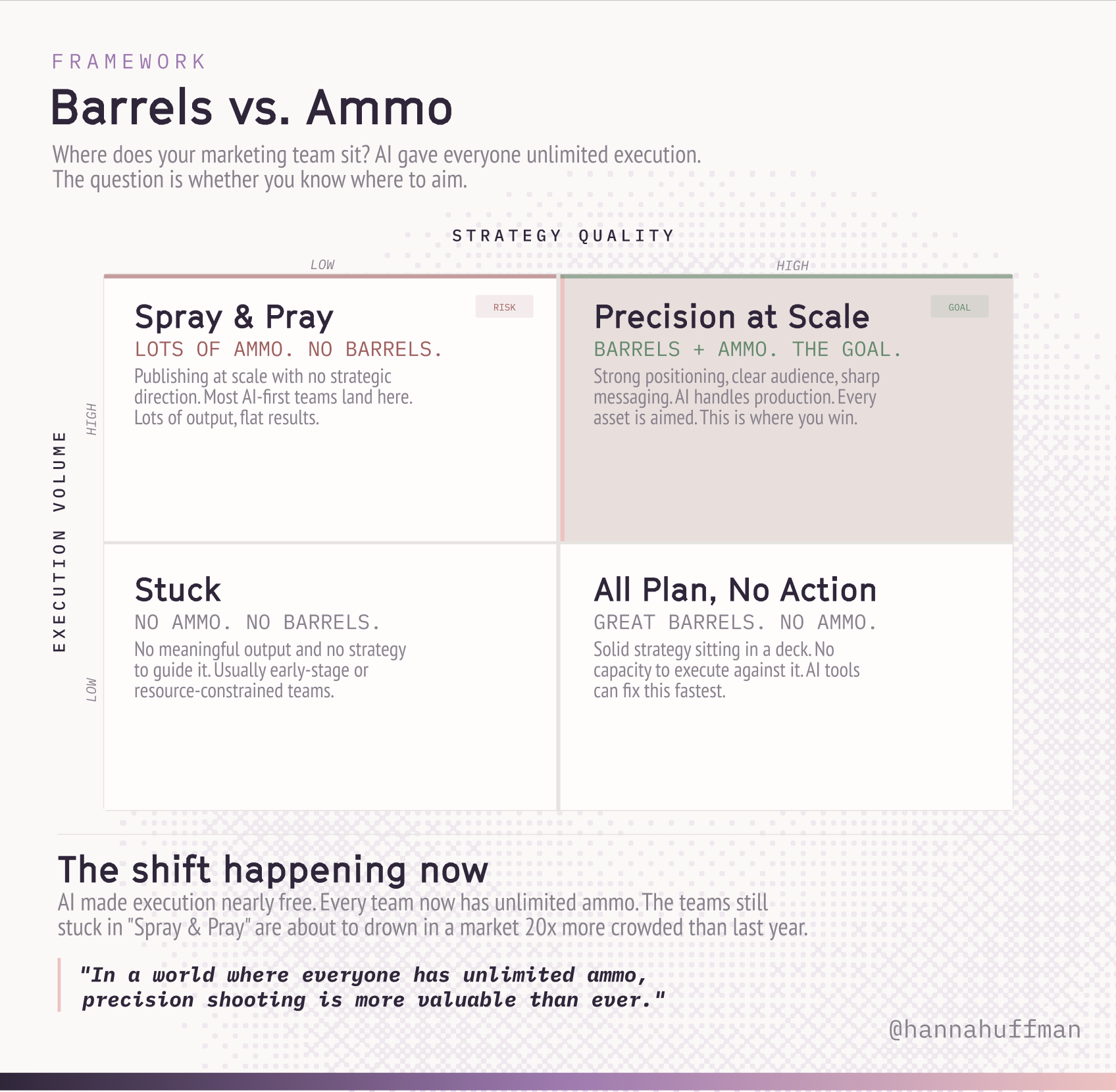
A lot of marketing teams are in this position and don’t realize it. They’ve got millions of bullets but they’re not really sure where to point them. They’re producing a lot of stuff but it’s not moving the needle. The business metrics are flat even though the output metrics look great. More emails sent, more posts published, more ads running. But revenue? Pipeline? Retention? Not much movement.
That’s why management consulting firms, whether you love them or hate them, command the fees they do. I spent years in that world, and what we were really selling was barrels. We’d get brought in by leadership teams that said some version of the same thing: “We have a really well-oiled machine. We’re doing a ton of stuff. But it’s not accomplishing our business objectives, and we think our strategy might be wrong.” They had all the ammo in the world. What they needed was someone to tell them where to aim.
I worked with a company recently that runs a content business. Their logic was straightforward: every piece of content generates a certain amount of monetizable engagement, so if we produce five times as much content, we get five times as much engagement to sell to advertisers. The shotgun approach. It sounds logical on a whiteboard, but it almost never works the way people think it will, because more content without better targeting, better quality, or better distribution just dilutes everything. The engagement per piece drops, the audience gets fatigued, the advertisers start noticing the quality decline, and you end up running faster to stay in the same place.
The uncomfortable truth is that for the longest time, execution was the most important thing in marketing. The team that could produce the most creative, manage the most channels, and ship the most campaigns won by default. Strategic thinking was something you did once every few years with a consulting firm or during an annual planning offsite. It wasn’t built into the weekly operating rhythm. Most marketing leaders, even senior ones, have deep executional knowledge and shallow strategic instincts. That’s not a criticism. It’s the result of an industry that appropriately valued production skills for decades, because production was the bottleneck.
That bottleneck is gone now. And the people who only know how to produce are about to find themselves in a very uncomfortable position.
AI is a replacement for good, not a replacement for great
Here’s where I want to land on this, because I think the AI-replaces-jobs conversation has been weirdly binary. One camp says AI replaces everything and we should all be terrified. The other camp says AI is just a tool and nothing is changing. Both are wrong, and the truth is more nuanced and more interesting.
What I’m seeing in practice is that AI is a replacement for “good.” Not a replacement for “great.”
Let me explain what I mean. Good, today, is roughly what you’d produce by hand with solid skills and decent experience. A well-structured blog post. A clean ad with reasonable copy. A competent email sequence. AI can produce that level of work, assuming you prompt it correctly and give it the right context, at roughly 90% of what a skilled human would create. That’s “good.” And “good” used to be enough, because producing good work at any kind of scale was genuinely hard.
Now it’s not hard. And that means good is rapidly becoming table stakes. When everyone can produce good, good stops being a differentiator and starts being a minimum. The new bar is great.
Great is different. Great is a website that doesn’t just function but feels alive. Custom textures, custom typography, organic motion design, hand-drawn illustrations that couldn’t have come from a template. The web design community is already moving hard in this direction. Figma, Adobe, and a dozen design trend reports for 2026 all point to the same thing: brands are pushing back against AI’s overly polished aesthetic by investing in work that feels human, imperfect, and unmistakably original. Scribble accents. Handwriting-style fonts. Retro-inspired details that add warmth and personality. The pendulum is swinging toward authenticity precisely because everything else is starting to look the same.
Great is a marketing campaign where the copy is built on actual user research, where the positioning eliminates unnecessary competition by choosing where to play and how to win, where the messaging reflects proprietary insights that competitors don’t have access to because you actually talked to your customers and they didn’t.
Great is the reason Anthropic is paying engineers $400,000 to $500,000 a year and staffing design roles at compensation levels that would have been unthinkable five years ago. In a world where anyone can produce a presentation in minutes, companies are paying a premium for people who will produce something with a perspective. Something that stands out. Something that makes you feel like a human with good judgment was involved, because one was.
This is the part that excites me, honestly. If you’re someone who knows how to think strategically, who has spent 15 or 25 years building judgment through real experience (the mistakes, the wins, the campaigns that flopped and the ones that worked, the teams you’ve managed and the markets you’ve studied), this is your moment. The executional barrier that used to separate “having a great idea” from “being able to bring it to life” is collapsing. These tools give strategic thinkers what I think of as Iron Man-like superpowers. You can take all of that hard-won judgment and actually execute against it at a speed and scale that was impossible before.
The difference between you and the person who was previously valued primarily for knowing the mechanical pieces is that you’re a barrel. You know where to aim. And in a world where everyone has unlimited ammo, precision shooting is going to be more valuable than ever.
But if you’re the person who’s been spending all your time celebrating how much you can produce, without stopping to ask whether it’s actually moving the needle, I’d pay close attention to what’s happening. The volume advantage is temporary. The strategy advantage compounds.
What to do?
If you’re reading this and thinking about where you fit in this shift, here are the things I’d actually do.
- Audit your ratio of production time to strategy time. Most marketing teams spend 90% of their time on production and 10% on strategy. That ratio needs to start moving. You don’t have to flip it overnight, but if you’re not spending meaningful time every week on positioning, audience research, competitive analysis, and messaging refinement, you’re going to fall behind. The teams that win will be the ones that think about how, why, and where they produce before they think about how much.
- Invest in learning strategy if you don’t already know how. I don’t mean “read a book about brand positioning.” I mean actually learn how to define your unique selling propositions, build a competitive positioning map, conduct customer research that surfaces real jobs to be done, and translate all of that into messaging that makes every dollar you spend on media more efficient. These are skills that were historically concentrated in management consulting and brand strategy firms. They charged $750,000 for this work because almost nobody on in-house marketing teams knew how to do it. If you learn it now, you become the most valuable person on your team at a time when that value gap is widening fast. Emily Kramer at MKT1 has excellent frameworks for this. April Dunford’s “Obviously Awesome” is still the best positioning book I’ve read. And Reforge’s growth strategy courses are worth your time if you can get access.
- Stop measuring your output by volume and start measuring it by impact. How many of the things you published last month actually drove a measurable business result? Not impressions. Not clicks. A result. A lead. A sale. A retained user. A conversation that turned into revenue. If you can’t answer that question, you have an ammo problem disguised as a barrel problem. You think you need better strategy, but what you actually need is better measurement so you can tell whether your strategy is working.
- Use AI to get to “good” fast, and then use the time you saved to push to “great.” The biggest mistake I see people making is using AI to produce more stuff at the “good” level instead of using it to free up time for the work that makes things exceptional. Write the first draft with AI. Build the campaign structure with AI. Generate the initial creative concepts with AI. Then stop and ask: what would make this remarkable? What would make someone screenshot this and send it to a friend? What would make this feel like it could only have come from us? That’s the work that compounds. That’s the work AI can’t do for you yet.
- Create original content and original research. In a world where everyone is producing content from the same publicly available information, the person who talks to real customers, runs real experiments, and publishes real findings has an unfair advantage. Interview your users. Survey your audience. Publish your own data. Take a stance that’s informed by firsthand knowledge, not just a synthesis of what’s already on page one of Google. The market is about to be flooded with repackaged conventional wisdom. Original thinking will be the scarcest and most valuable resource in marketing.
I want to be clear: I’m genuinely excited about what AI enables. The ability for a startup founder or a solo operator to run a real marketing program without a 10-person team is extraordinary, and I think we’re going to see incredible businesses built by people who pair good judgment with these tools. That’s the whole thesis behind what I’m building at MultiplAI with Cursor_CMO.
But there’s a real word of caution that needs to be louder right now. All these YouTube tutorials and X threads about producing 5 billion LinkedIn posts a day and publishing 10 Substack articles a week are optimizing for the wrong thing. They’re celebrating volume when they should be interrogating value.
The people who win in the post-AI marketing era are the people who know the difference between “hot and ready” versus good. Between ammo and barrels. Between production and precision. Between output and outcomes.
So the next time you’re about to hit publish on something AI helped you produce, ask yourself three questions: Is it hot? Is it ready? But is it good?
And then ask the harder one: is it great?