Marketing is becoming the most valuable skill in tech.
Marketing is becoming the most valuable skill in tech, not because marketing changed, but because building got easy and distribution will be harder than ever.

Something unusual happened on tech Twitter over the past two weeks. Not the usual AI hype cycle. Not another framework debate. A growth lead at an AI company named Sandra Zizak posted a simple prediction: the highest-paying job in tech will soon be marketing.
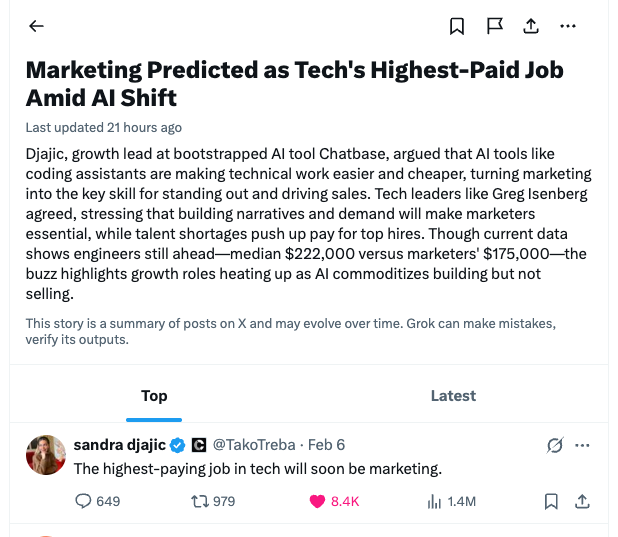
Within days, Codie Sanchez adapted the idea, arguing that whoever owns distribution owns deals, LPs, and everything that follows. Brian Balfour posted a detailed thesis about how AI has inverted the go-to-market stack entirely. Lenny Rachitsky jumped on the train later in the week.
What caught my attention wasn’t any single post. It was the convergence. These aren’t people who coordinate their takes. They arrived at the same conclusion independently, from different corners of the industry, in the same two-week window. When that many unconnected voices say the same thing at the same time, something real is shifting.
They’re all pointing at the same truth: the bottleneck in tech is no longer building. It’s finding customers.
Why That’s Happening Now
The mechanism is straightforward, even if the implications are enormous. AI coding tools have fundamentally changed what it means to build a product. A person with no engineering background can create a functional web application in an afternoon. You can debate whether the output is production-ready, but the tools are getting better every month, not worse. The trajectory only goes in one direction.
The supply of software is exploding. Every founder with a thesis, every solo operator with a weekend idea can now ship product. The barriers to creation have collapsed so dramatically that my favorite tweet of the entire thread captured it perfectly: “Vibe coding democratizes the ability to discover you suck at marketing.”
That line landed because it names something most people in tech haven’t fully processed. When anyone can build anything, building stops being the differentiator. The question shifts from “can we make this?” to “is it necessary?” and “can anyone find it?” And that third question, the one about distribution, about positioning, about understanding who needs what you’ve built and how to reach them? That has always been marketing’s domain. Most technical teams just never had to care about it this much before.
This pattern isn’t new. It just hasn’t been this visible. Peter Thiel wrote in Zero to One that poor sales, not bad product, is the most common cause of startup failure. He wasn’t being provocative. He was describing something that has repeated across decades of tech history, and the examples are brutal.
- Rdio launched a full year before Spotify entered the U.S. market. Critics consistently rated it the better product: cleaner design, better social features, more intuitive experience. But Rdio had, according to a former employee, “no one looking over marketing whatsoever.” The company never retained a CMO for more than a few months. Meanwhile, Spotify built an aggressive freemium funnel, locked in celebrity partnerships, and integrated deeply with Facebook’s platform. By the time Rdio introduced a free tier in 2013, Spotify had already sprinted to 75 million users. Rdio filed for bankruptcy in 2015 and sold its remains for $75 million. The better product lost because nobody was thinking about distribution.
- Google Wave might be the most instructive example for today’s AI builders. Launched in 2009, it combined email, messaging, and document editing into a single real-time collaboration platform. Many of its core concepts showed up years later in Slack, Google Docs, and Notion. But Google did almost nothing to explain what Wave actually was or who should use it. Users who received invites didn’t know what to do with it. It shut down in 2012. Brilliant technology that died because nobody could articulate what problem it solved for whom.
- Then there’s Segway. Over $100 million in R&D. Dean Kamen predicted it would be “to the car what the car was to the horse and buggy.” But Segway was marketed simultaneously to commuters, delivery workers, tourists, and general consumers, which is another way of saying it was marketed to nobody. Over 19 years, only 140,000 units sold. The underlying technology eventually succeeded in e-scooters and hoverboards, but only when other companies wrapped the same core innovation in clear positioning, lower price points, and real distribution.
Harvard Business School estimates that 95% of the roughly 30,000 new products introduced each year fail. The dominant reasons are not technical. They are market-facing: no validated need, insufficient promotion, poor timing, and ignoring customer feedback.
The flip side of the graveyard is just as revealing. The companies that broke through? Marketing wasn’t a supporting function. It was the main event.
- Salesforce was a nobody in 2000 while Siebel held 45% of CRM. Marc Benioff staged a fake protest outside Siebel’s user conference and rented every airport taxi to plaster with the “No Software” logo. News crews showed up. Within three years, Siebel was acquired by Oracle. “No Software” as a positioning statement is what forced the market to pay attention.
- Dropbox grew from 100,000 to 4 million users in 15 months through a referral loop that saved an estimated $48 million compared to paid acquisition.
- HubSpot coined “inbound marketing,” built a certification program and conference around it, and made the concept synonymous with their brand. That positioning choice is the foundation of a company now worth over $20 billion.
I’ll admit: this one hits different.
I’ve spent my entire career in marketing, product marketing, and growth roles. For a lot of those years, I’ve watched my “technical” peers design and build our product from afar. When you’re “marketing”, you’re the one who makes the ads. You’re the one who sends the direct mail. You can be the last to know when a new feature ships, even though you’re the one who’s supposed to explain it to the market and make money with it.
I’ve lived the consequences of this more than once.
- There was a product launch where marketing was brought in after the product was fully developed. It was “ready to go as soon as marketing is ready.” Everyone was proud of the build. But nobody had consulted marketing on what the incremental audience reach of that specific release would actually be. The TAM impact turned out to be far smaller than the business needed, because a different feature (one that would have unlocked a much larger addressable market) had been deprioritized instead. We missed quarterly revenue targets. Not because the product was bad. Because the prioritized release was built for a target market way smaller than desired, and the people who understood the audience weren’t in the room when the prioritization decision was made.
- Another time, a feature shipped without a validated user story behind it. Marketing had social listening data showing exactly what customers were struggling with, granular pain points that could have shaped the solution from the start. The feature addressed three of five real customer needs. Pulling marketing in earlier would have made it significantly more impactful. Instead, it landed with a shrug.
These aren’t unusual stories. Ask any seasoned marketer and they’ll have their own versions. Marketing gets treated as the last mile when it should be involved from the first conversation.
And here’s the part that founders building with AI tools really need to understand:
Marketing is not "just run some ads." The martech landscape now contains over 15,000 tools. The average B2B company operates across 11 marketing channels simultaneously. More than 40% of all digital ad spend is wasted, and that number gets worse, not better, when the person managing it doesn't know what they're doing. In Q2 of last year alone, $26.8 billion in programmatic ad spend was lost to fees, fraud, and low-quality inventory.
I’ve managed $3 million a month in ad spend— and that’s on the lower end of what most seasoned marketers are accountable for. All eyes on that number at all times. If you sneeze in the wrong direction, you lose a couple hundred thousand dollars that month. Knowing which channels to invest in, what to say in each one, how the targeting capabilities work across every platform where you buy media, managing multiple customer segments that each need slightly different language, coordinating across agencies and web teams. The operational complexity is real, and getting it wrong is expensive. CMOs have the shortest tenure in the C-suite at 4.1 years. Not because marketing is easy. Because the accountability is immediate and the margin for error is thin.
What to do?
So here we are. AI has made building dramatically easier. The supply of products is exploding. And the skill that separates the ones that make money with their idea from the ones that die in obscurity is the same skill it has always been: distribution. Positioning. Understanding who needs what you’ve built, where they are, what they care about, and how to earn their attention without burning through your runway.
Brilliant minds in growth, product, and marketing are simultaneously converging around an integrated product and distribution motion.
The people who will thrive in this next era aren’t pure engineers, pure product managers, or pure marketers. They understand enough about user research, product thinking, and distribution strategy to connect the dots across all three. Of those skills, the one that will be hardest to find and most expensive to get wrong is marketing. Knowing how to take something to market, how to position it against alternatives, how to build demand without wasting capital? That takes years of pattern recognition that no AI tool can shortcut for you.
If you’re a founder or entrepreneur building on top of AI right now, marketing is the thing you aren’t thinking about enough. You will need to get it right to ever make money on that startup. Don’t neglect it. Find someone who knows how to do it well. If your entire marketing strategy comes out of ChatGPT, you’re going to waste real money, and your product may never find its customer.
And if you’re a marketer or an agency? Get ready. In a world where anyone can build anything and the market is flooded with new apps and services from every direction, the new bottleneck in tech is being seen by the right people, standing out, and winning customers. You’re about to have more work than you know what to do with.