The Strategy Chain: From Discovery to Positioning

Most AI marketing content starts in the wrong place: Write fifty LinkedIn posts. Generate ad creative. Automate your email sequences. Build a landing page in two minutes.
All of that is execution, and execution is the easy part. Knowing what to say, to whom, and why it matters more than what everyone else is saying? That's the work nobody wants to do. And if you skip it, all the AI-generated content in the world won't save you. You'll just produce mediocrity faster.
The first two skills in the Cursor CMO system exist to solve this problem. They force you to do the strategic work that a $400K-a-year CMO does in their first month, before a single ad runs or a single post gets written.
Discovery Intake collects the raw context. Positioning Strategy turns it into a competitive advantage. This is where the chain begins.
This piece covers:
- What Discovery Intake actually asks (and why most teams never bother)
- How Positioning Strategy picks a fight you can win
- Why doing this work first makes everything downstream work better
Discovery Intake: the questions most teams never ask
Here's a pattern I've watched play out dozens of times across fifteen years of growth work:
- A company hires a marketing lead, an agency, or a fractional CMO. Within two weeks, that person is producing deliverables. Social posts. Landing page copy. Campaigns. Everyone feels productive.
- Six months later, nothing is working. The messaging doesn't resonate. The targeting is off. Campaigns generate clicks but not customers.
- The diagnosis is always the same: nobody stopped to collect the foundational context that makes all those downstream activities work.
Discovery Intake is a collection of skills (a workflow) I built to prevent that failure mode. It's the mandatory entry point for the entire Cursor CMO system. Nothing else runs until this is done.
What it actually walks through
The skill covers five phases of structured questioning:
- Business context: What stage you're at, what your primary goal is for the next six months, how you'd describe your product to someone at a party with no jargon.
- Product and customers: Who buys today, why they choose you over alternatives, and what they say in their own words about why they came to you.
- Current state: What tools and channels you're running, what's worked, what hasn't, what you've tried and abandoned.
- Challenges: Where you're stuck, what your budget looks like, what resources you actually have.
- Assets and evidence: Proof points, case studies, competitive intelligence, anything that substantiates your claims.
The key design decision is that it collects everything upfront. Most intake processes get spread across weeks of meetings, drip-fed through Slack messages and "oh, one more thing" emails. By the time you've gathered enough context to do real strategy work, you've already started producing deliverables based on incomplete information.
Messy, incomplete, stream-of-consciousness answers are fine with this tool– just turn the mic on and let it flow. Something I do a lot is just dictating the answers to each question in an "interview" style using a tool like Wispr Flow– sometimes, directly from the Brand Leader, CEO themself, or Sales leader. The point is getting it all in one place before any recommendations get made.
Why the output format matters
The output is a single structured markdown file that every downstream skill reads from. When Positioning Strategy runs, it loads the Discovery artifact automatically. When ICP runs, same thing. Brand Strategy, same thing. The context compounds across each step because there are no handoffs where information gets lost.
This might sound simple. It is! That's the whole point. The reason most marketing programs produce generic work isn't that the people are bad at their jobs. Nobody did the boring, thorough work of understanding the business before jumping to tactics. The Discovery workflow enforces the discipline that most teams skip.
Positioning Strategy: choosing the fight you can win
If Discovery is about understanding the business, Positioning is about understanding the market and then choosing where to compete.
Why Jobs to Be Done (and not competitive analysis)
The skill uses a JTBD methodology, and there's a specific reason for that. Traditional competitive analysis looks at your market through a category lens: you pull up the Gartner magic quadrant, identify the VC-backed startups in your space, and position against them.
This is often a mistake. Most of your market isn't evaluating those alternatives. Most of your market is doing the job some other way entirely.
Mapping the real competitive landscape
The skill maps all alternatives across four categories:
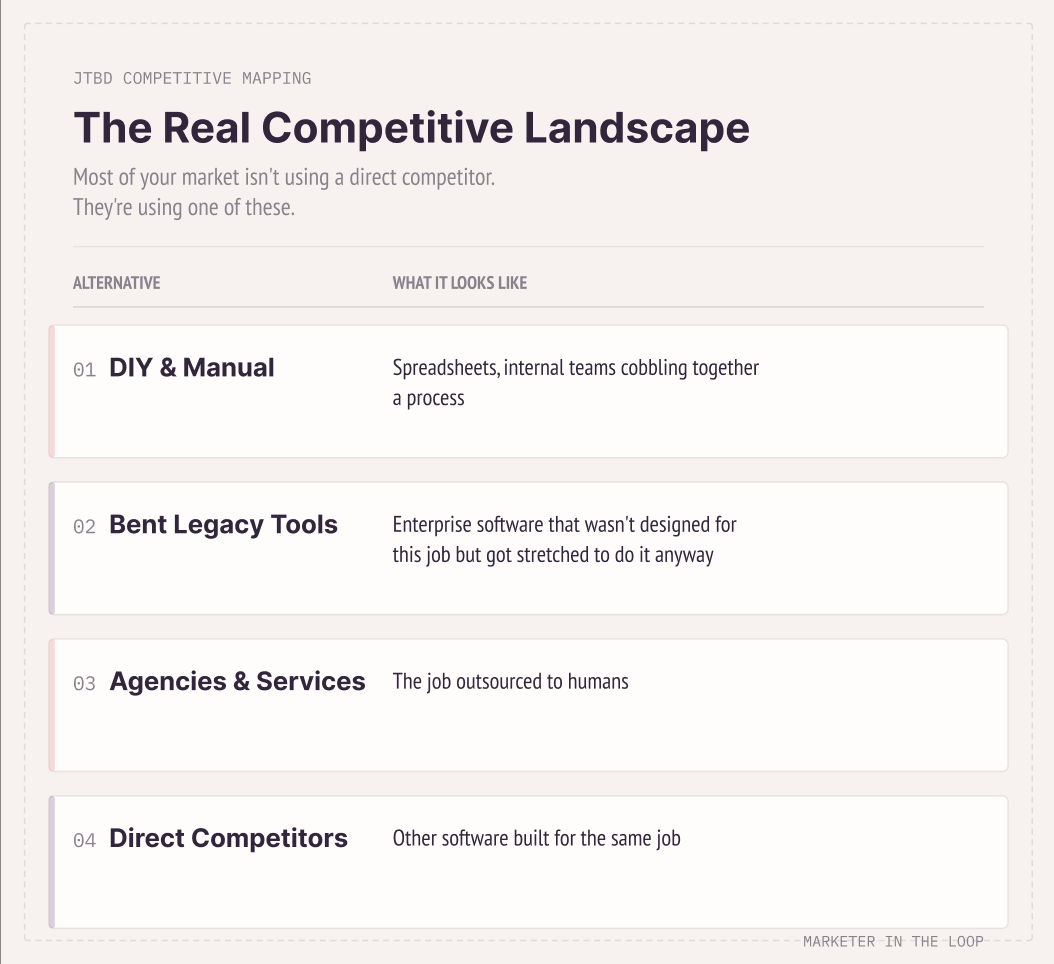
For each one, the skill asks why customers choose it, what job it solves, what breaks down, and how common it is.
This is where most of the insight lives. When you see the full landscape through a JTBD lens, you almost always discover that the majority of your target market isn't using a direct competitor. They're using some combination of spreadsheets, an agency, and a legacy tool that does 40% of what they need. That changes your positioning entirely. You're not always competing against another startup's feature set. You're competing against inertia.
The hardest decision most companies avoid
Once the landscape is mapped, the skill forces a choice: pick ONE alternative to position against. Not two. Not "it depends on the segment." One.
Your differentiation story changes completely depending on which alternative you anchor against. Anchoring against agencies means you talk about speed, cost, and control. Anchoring against DIY means sophistication and scale. Against legacy tools, it's purpose-built design and simplicity. Trying to anchor against everything gives you bloated, generic positioning that doesn't land with anyone.
Three questions identify the right anchor:
- Where is the majority of your target market today? (Not where you wish they were.)
- Which alternative creates the problem your product solves best?
- Which one will resonate in ten seconds? Because marketing doesn't give you thirty minutes to explain tradeoffs.
After anchor selection, the skill builds the differentiation case and produces three positioning outputs: a one-liner, an elevator pitch, and homepage positioning copy. All three are built from the same anchor and the same customer language extracted from Discovery, so they're consistent by default rather than someone trying to reverse-engineer consistency after writing them independently.
Why the chain matters
I'm building this series this way for a reason.
Most content about AI in marketing focuses on the last mile. How to generate more content, faster. How to automate workflows. How to save time on tasks that used to take hours. That work is real, and I'll cover it later. But the leverage isn't there.
The leverage is in the strategic decisions that shape everything downstream. Who you're competing against. How you're different. Who you're talking to. What you're actually saying.
When those decisions are right, your execution works dramatically better, whether it's AI-powered or not. When they're wrong, it doesn't matter how fast you can produce LinkedIn posts.
I've run Discovery and Positioning for companies ranging from pre-revenue startups to $200M PE-backed enterprises. The pattern is consistent: teams come in with a vague sense of who they compete with, generic messaging that could apply to anyone in their space, and marketing programs that generate activity without generating customers. They leave with a clear competitive anchor, specific differentiation, and messaging that actually resonates with the people they're trying to reach.
What to do?
Here are two questions to pressure-test your own positioning right now:
- Could you explain, in one sentence, what alternative your target customer is using today instead of your product? Not a competitor. The spreadsheet, the agency, the manual process. If you can't answer that clearly, you don't have positioning. You have a feature list.
- If you had to pick one competitive anchor for every piece of marketing you produce, which would it be? If the answer is "it depends" or "all of them," that's the problem. Positioning requires sacrifice. You have to choose the fight you can actually win and let the rest go.
The Positioning Strategy skill forces both of these decisions. And every skill that runs after it (ICP, Brand Strategy, Content Strategy, Design Systems) inherits the clarity they create.
Marketer in the Loop subscribers get access to the full Skills MCP. One config line in Claude Code, and both skills are available to run immediately. The output feeds directly into the rest of the strategy chain.
Next week: how the system knows your customer better than they know themselves, and why most ICPs are worse than useless.
About Marketer in the Loop
Marketer in the Loop shows how an AI-native marketing practice gets built: what worked, what broke, and what you can use in your own system. It is published by MultiplAI Growth Partners, which helps agencies and marketing teams turn scattered AI experiments into working systems.
Build it yourself with MITL Pro
MITL Pro includes the MITL MCP, every current and future suite, downloadable templates, prompt packs, practical frameworks, the full Pro archive, and a 20-minute call with Hanna. Install one connector in Claude Code or another MCP-compatible client, then use the system from the tools you already work in.
Want a roadmap built around your business?
The Agentic Consult is a free, on-demand 8–10 minute conversation with an AI operating advisor. It asks what result you want, what you’ve tried, what worked, what didn’t, and what is blocking you. Hanna reviews the output, and your personalized roadmap arrives by email within an hour—with a clear diagnosis, three prioritized systems, an implementation sequence, and a measurement plan.
Free. No calendar booking required.