How to: Make Life-ful Marketing Outputs with AI
Before you automate a marketing workflow, find the human intelligence that makes its best output worth reading, trusting, and acting on.

Last week I wrote a LinkedIn post about how tired marketers are of being handed an AI “magic button” and told to transform the business with it.
It reached 210,754 people, drew 2,486 reactions, and collected 317 comments. I read the discussion closely. It isn't a survey, and I won’t pretend every commenter said the same thing. But people went out of their way to describe a remarkably consistent problem:
They're being asked to transform their work with AI, but nobody has made room for the work of transforming it.
The people responding weren't anti-AI. A lot of them already build with it. They're taking courses with their own money, learning tools at night, rebuilding workflows on weekends, and keeping the full-time job moving while expectations grow.
One person put it this way:
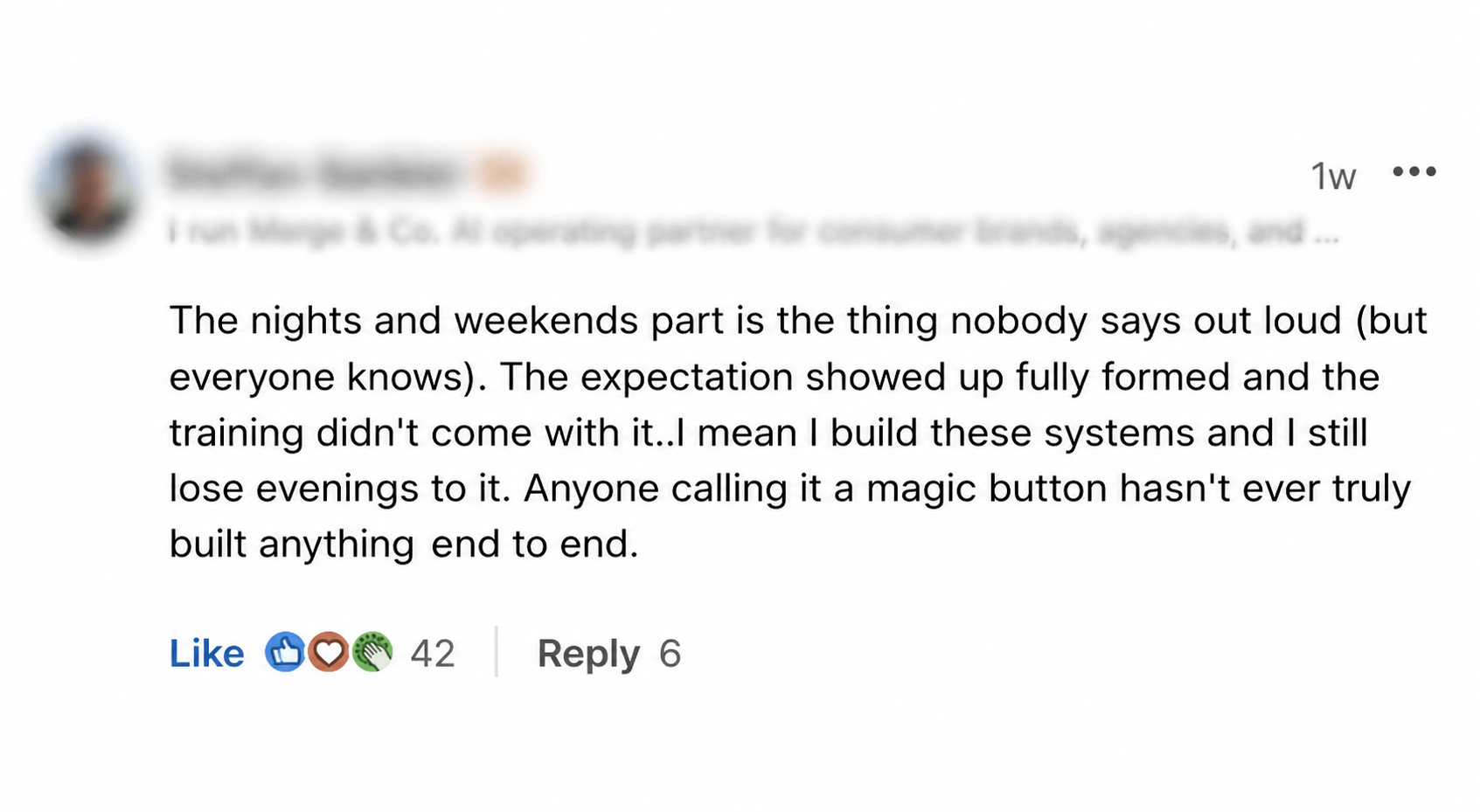
That comment got 42 reactions because it named the part leaders often miss: The license is easy. The learning, redesign, quality control, documentation, and team support are the work.
One marketer I spoke with this week told me she learns this stuff on her own time because she wants to know she'll still have a job in a few years. Her exact point: “I became and now operate as the Expert, taking on what feels like another job. But my title hasn't really changed. Compensation hasn't changed. Just have another 15-ish hours a week of work I do now that is extra.” Her team has also started sending weak AI-generated work back with a simple question: “Can you explain and defend this?” The problem: “delegated thinking” to AI.
That's the deal a lot of marketers feel they've been offered: become the company's AI expert in your spare time, share what you built, keep your old workload, and hope the expertise doesn't automate you out of the org chart.
Then another conversation today helped me name a different kind of exhaustion.
When you've been doing something for 15 years, you can usually tell the difference between a possible answer and the best answer for this situation. That doesn't make you infallible. It means you've built pattern recognition, customer knowledge, and judgment that help you choose the next right move, then prove or disprove it through performance.
The lazy read is that the expert “just wants to do what they want” or “isn't patient enough to bring people along.”
That's not it.
I don't mind being challenged. I mind when every decision turns into a trial where 15 years of experience has to rebut a decontextualized Claude answer line by line before anyone can act. I don't want to spend 80% of my time debating plausible suggestions and 20% doing the work, measuring performance, and learning what actually happened. I want that ratio the other way around.
Or, more plainly: I don't want to argue with Claude through you. This isn't about ego or refusing input. It's about where the team's best thinking goes.
Claude can give you a possible answer. The person accountable for the work still has to find the best answer for this customer, this brand, this team, and this moment. If the expert has to win a debate against the model every time, the team isn't getting smarter. It's spending its best thinking on an argument no customer will ever see.
That's how taste and judgment get automated out of the work. Not through one dramatic decision, but through a thousand small overrides. The original idea gets replaced by the easier-to-defend average. Customer language gets swapped for category language. The experienced person who knows when something is wrong gets treated like a blocker because Claude produced something that sounds confident.
Many people in the comments saw the same danger:
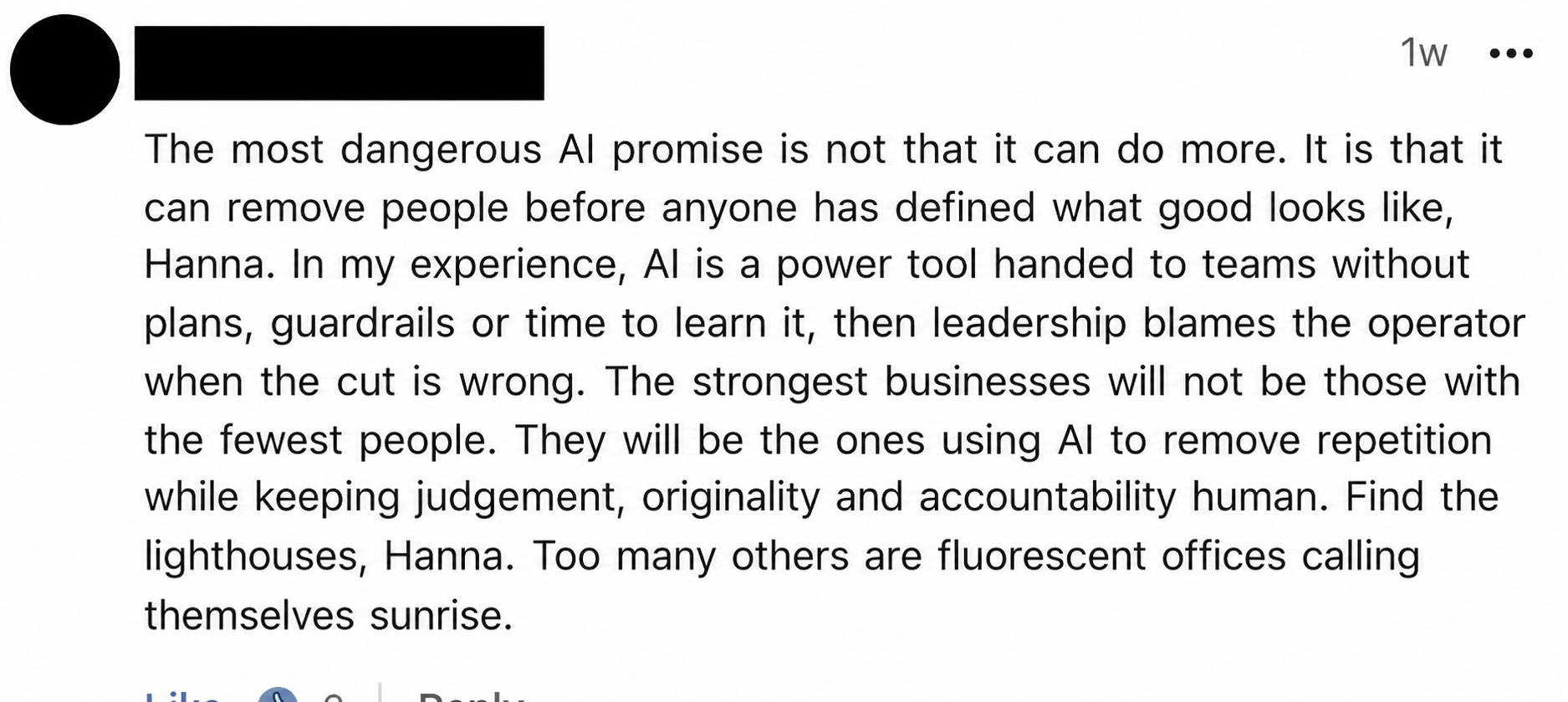
They weren't defending busywork or asking for less accountability. They were defending the intelligence inside the work, and they wanted a practical way to protect it.
What I recommend: before you automate a workflow, find the human intelligence that makes its best output better than a merely possible answer.
Keep reading to learn how I make life-ful marketing assets using humans in the loop.
Pardon my interruption:
I'm considering a limited, free pilot in September called Lighthouse Working Sessions. There won't be webinar theater or a claim that I can fix your entire AI transformation in 45 minutes. The idea is a small group with limited slots, working through one real marketing or AI operating problem together.
You come with a problem you want to solve together, and I screen share and we fiddle around with it to get it working a bit better for you; or, we build you a scrappy prototype.
It isn't launched, and there aren't slots to book yet. If you might want to join, reply and tell me if you or someone you know would be interested in these sessions.
I think of this as a Workflow Intelligence Audit. You study ten examples of the work at its best, map how those examples came into existence, and identify the information and judgment a model couldn't have supplied on its own. Then you decide what should stay a human gate, what can become reusable context or a standard, and what's actually safe to automate.
This matters because an AI system can't preserve intelligence it was never given.
You need a marketer in the loop. (Don't hate me, I had to. It's the whole reason I named this newsletter "Marketer in the Loop".)
Faster content isn't better when the workflow loses its proprietary intelligence
The "unhappy path" usually starts with a reasonable goal. A team wants to produce content faster, serve more clients, or give an overloaded marketing function some breathing room. Someone opens ChatGPT, pastes in a general topic or a thin brief, and asks for a blog post.
Soon the system can fulfill the monthly request for ten blog posts. The production dashboard is green. Every row has an owner and a due date and, technically, the content exists. Meanwhile, social engagement barely moves. Reach, followers, and leads stay stubbornly flat. Sales doesn't use the work. Customers don't recognize themselves in it.
I tell clients this is the Output Factory Trap: a team automates the visible labor, keeps the output target, and accidentally removes the intelligence that made the work capable of producing a result. It's easy to miss because we've spent years counting deliverables. We can prove the machine shipped something while avoiding the harder question: did anyone find it useful? Did it work?
The problem isn't that an LLM drafted the copy. Drafting is often exactly where AI should help. The problem is treating the draft as the whole workflow when it's only one step in a system that also needs customer conversations, sales examples, editorial judgment, creative decisions, and performance feedback.
Delete those inputs and the model does what it can with what's left. It averages the public web into competent sentences. The result sounds correct because there isn't anything unusual enough to be wrong. Or, as one marketer told me, “everyone's copy is the same.”
Don't delete a step until you understand what intelligence it contributes. A twenty-minute conversation may look inefficient while carrying the only proprietary detail in the system. An editor's review may look like a bottleneck while containing the team's unspoken standard for “good.” A sales call may look unrelated to content while supplying the example that makes the article credible.
Learning the AI tool is maybe 20% of this work. The harder 80% is redesigning the workflow around it: roles, inputs, review loops, quality gates, performance signals, and the rules that tell the team when a human needs to step in. That's why another tutorial rarely unsticks an overwhelmed team. The tool is waiting. The operating decision isn't.
Start by asking what your best work knows that AI doesn't
Run the audit on one workflow, not all of marketing. Choose something repeatable and consequential enough to matter, but bounded enough that the people in the room can map it without starting a six-month transformation program.
A monthly webinar-to-content system is a workflow. A proposal-development process is a workflow. If your first diagram needs twelve swim lanes, keep narrowing (I say this as someone who can turn almost any problem into an unreasonable diagram).
The purpose is not to produce a list of tasks that AI could theoretically perform. You are trying to find the intelligence hidden to the ai doing the task that explains why some outputs from this workflow are better than others. Not so you can "automate" them away; but, so that you can preserve them.
Step one: Pick one workflow worth improving
Pick a workflow with a real reason to improve. Maybe it takes too much senior time. Maybe it can't handle another client without another hire. Maybe the team is producing more but performance has stalled. Maybe the workflow depends on one person who can't take a vacation without becoming a Slack escalation channel.
Write down the start and end points in plain language. For example: “From a completed subject-matter-expert interview to an approved newsletter, social package, and visual brief.” Name the current owner and the people who materially shape the result.
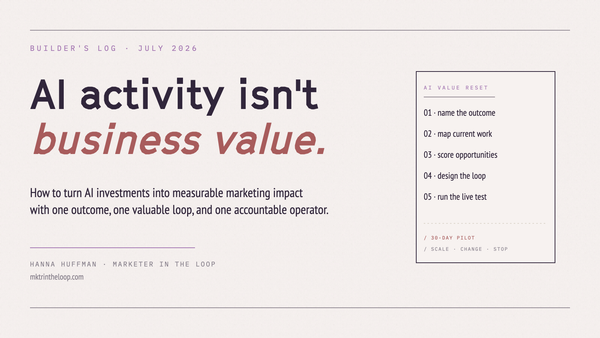
Don't spend this session redefining the business goal. If the outcome, baseline, or performance signal is still fuzzy, use The AI Value Reset first. The audit assumes you know what improvement means. Its job is to help you change the workflow without destroying the reason it performs.
Step two: Bring ten examples of great work
Assemble ten examples the team considers genuinely strong. They don't all need to be the ten highest-performing assets, because performance data is noisy and quality has more than one dimension. Include work customers responded to, sales reused, senior editors approved quickly, or subject-matter experts said finally sounded like them.
Then ask questions that force the room past “I just know good work when I see it.”
- What specific detail could not have come from a search result or generic brief?
- Where does the work sound like this company, customer, or expert rather than its category?
- What did the creator choose not to include, and why?
- Which example changed a customer's understanding, a sales conversation, or a next step?
- Where did an editor make a judgment call that is not written down anywhere?
The ten examples matter because teams routinely document the process they are supposed to follow, not the process that produced the thing everyone loves. The exemplars keep the conversation honest. If the workflow map says a step is optional but every excellent output contains evidence from it, the evidence wins.
Step three: Map how the work actually happens
Map every step from intake to performance review using verbs: prepare the interview, conduct it, extract claims and examples, choose the narrative, draft, edit, verify, build the visual, approve, distribute, and review performance.
For each step, capture who does it, what they receive, what they decide, what they produce, and what tends to go wrong. Note the weird side channels too: the Slack message from sales, the voice memo from the founder, the customer objection someone remembers from a call six months ago. That mess may be carrying more value than the official brief.
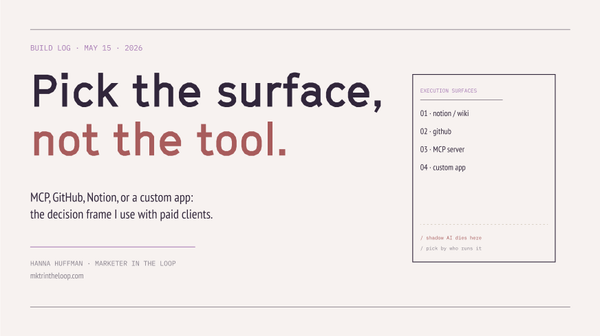
If the workflow already lives partly inside one person's private AI setup, map that too. A team capability can't depend on a prompt nobody else can find or context that only exists in one chat history. I wrote a separate guide on where a team's AI workflows should live, but location comes after understanding. Moving a weak workflow into a shared repository only makes the weakness easier to distribute.
Step four: Mark what the model can't already know
Now go step by step and ask: What information or judgment enters here that the model could not know before this workflow began?
In a strong content workflow, that might be a subject-matter-expert interview containing details about the real ideal customer, what buyers tried before, why it failed, how sales describes best fit, and which examples are safe to use. That isn't reliably available on the public web or in the CRM. It exists because one person asked a good follow-up question and another trusted them enough to answer it.
Judgment is harder to spot because experts make it look effortless. An editor removes a sentence that's accurate but sounds like every other B2B company. A strategist sees that the obvious hook will attract the wrong audience. A customer-facing operator notices that the model's “pain point” is language no customer has ever used.
Ask the expert to narrate the decision. What did you notice? What options did you reject? What evidence changed your mind? Which rule did you apply? When would you make the opposite choice?
Sometimes the answer will be clear enough to document. Sometimes it'll be “I need to see it in context,” which is annoying but useful. Tacit judgment doesn't become fake just because it resists a tidy checklist (sorry to every process diagram I have ever loved).
Step five: Choose preserve, codify, or automate
For every hidden-intelligence input, make an explicit decision.
- Preserve it as a human gate when the judgment is high-stakes, deeply contextual, rare, or still difficult to explain. The human isn't there to clean up random sentences after the model runs. They own a named decision, such as approving the core narrative, validating a customer claim, or deciding whether the final work meets the bar.
- Codify it into reusable context or a standard when the team can explain the decision well enough to make it teachable. This might become an editorial rubric, a set of approved examples, an audience language guide, a quality checklist, or a context file containing real customer objections. Codification doesn't mean freezing taste into a giant prompt forever. It means giving the next person and the AI a better starting point.
- If the intelligence isn't available yet, codify how the team will collect it before AI runs. Keep the SME interview. Add a sales-insight form to the monthly workflow. Pull customer questions from calls. Ask the account lead for one example of what worked and one example of what failed. A database can't contain knowledge nobody collected.
- Automate the repeatable transformations only after the inputs and gates are clear: organizing the transcript, extracting claims, turning approved source material into channel-specific drafts, checking required elements, or routing work for review.
The language here matters. Preserve, codify, and automate aren't maturity levels where “automate” is the prize. They're different design choices. A healthy system will contain all three.
Step six: Test one small change and watch performance
Choose the smallest pilot that can test the design. Run it on one client, one campaign, one webinar, or one month's content package. Keep the protected inputs and human gates visible. Document what the model received, what it produced, where humans changed it, and how long each stage took.
Then review the performance signal you already selected. Did the work save senior time without increasing rework? Did it create more usable assets from the same source? Did customers engage more? Did sales use it? Did the team reinvest the recovered capacity into something more valuable, or did leadership quietly fill the space with another ten deliverables?
That last question isn't soft. Reinvestment is an operating decision. If nobody decides where the time goes, the Output Factory Trap™ will decide for you.
One agency got better results by automating transformation, not human insight
I watched this distinction change a monthly content system for a content-led growth agency. The team wanted to make its webinars, newsletter, brand social, and founder-led social less time-intensive so it could serve more clients without adding headcount at the same rate and improve client performance.
The tempting approach was to ask which people could be removed from production. Instead, we asked a better question: What makes the current human-created work excellent?
The answer wasn't “someone writes a clean first draft.” What mattered most was an interview with a subject-matter expert. It produced proprietary detail about the ideal customer, real examples, what had worked and failed, what sales was hearing, and which companies were actually the best fit.
Without the interview, the AI could draft faster. It couldn't invent those facts. Without them, every downstream asset would become a more polished version of what the internet already knew.
So the new system kept and systematized the interview, then automated the repeatable transformation and drafting downstream. One source conversation could move into the webinar, newsletter, social posts, and founder-led content without asking a human to rebuild the same raw material four times.
The team reinvested the recovered time in copy editing, infographics, visual aids, motion graphics, and downloadable tools and templates. AI took more of the repeated motion so people could add more value around the work.
Social engagement improved 70% in the month after implementation. The content also improved its pipeline-generation performance. That didn't happen because we eliminated the people who understood the client. It happened because we accelerated those people and gave them more room to make the output useful.
This is what a healthy lighthouse team looks like. It isn't a magical group you discover fully formed after the rest of the organization disappoints you. You can deliberately build one by choosing a real workflow, protecting the people closest to the customer, making their intelligence reusable, and reinvesting capacity into quality.
One reader made that point better than I did. Lighthouse status isn't fixed. Teams can grow into it.
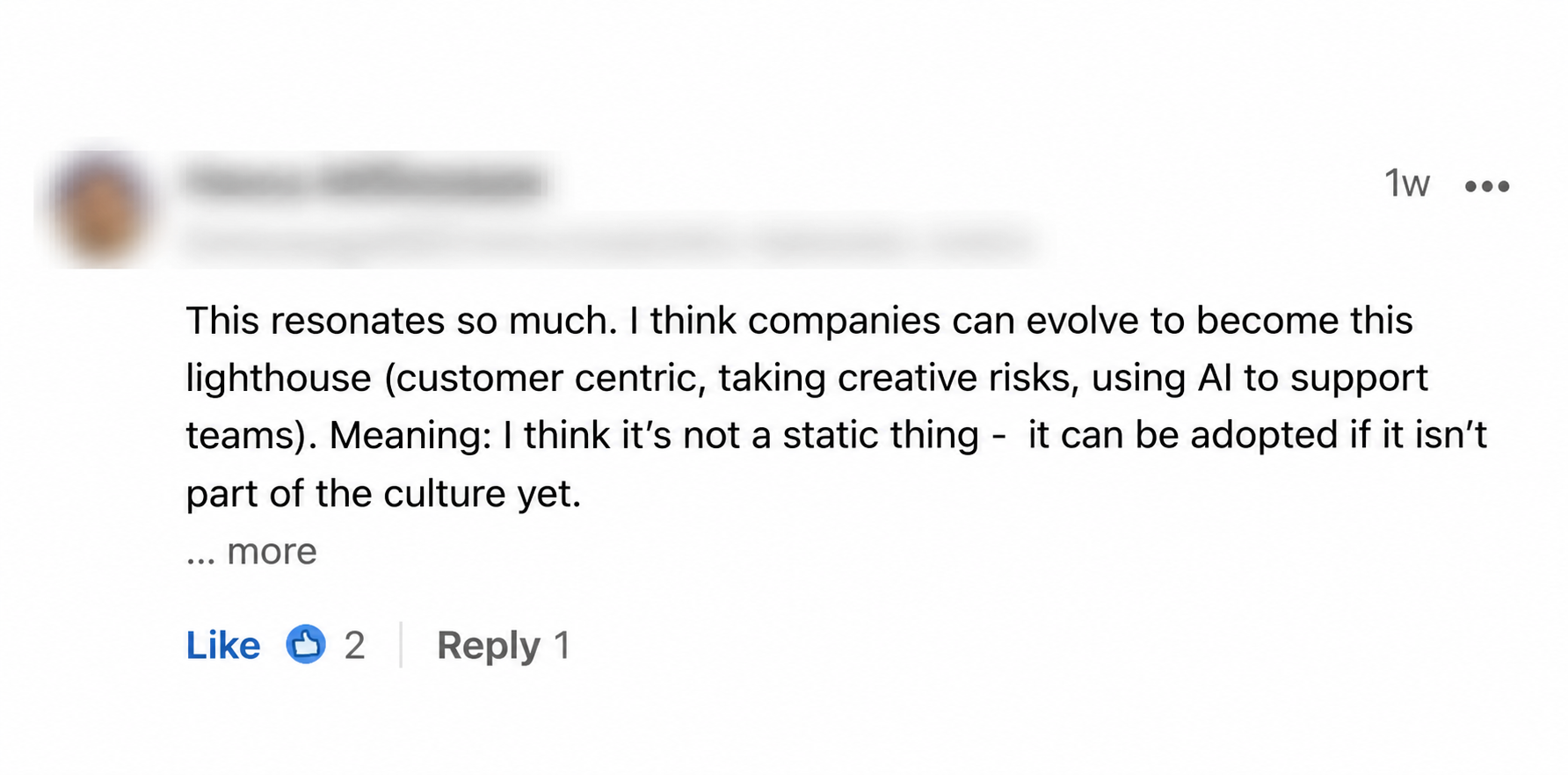
There's still change management involved. Someone has to own the system. Someone has to define what good output looks like. The team needs a shared place to run and improve the workflow, and people need training that goes beyond which button to press. This is the move from one clever power user to a Team OS.
Run this audit in 60 minutes next week
Put one hour on the calendar. Invite the workflow owner, the functional expert or owner of the best examples, and someone close to customer or performance results. For content, that might be the content lead, the subject-matter expert, and the account or sales lead. Three to five people is enough. Twenty people is a town hall, not an audit.
Bring ten exemplar outputs and the current process, even if it's a half-accurate Notion page plus what one person remembers. Don't spend the hour comparing AI tools or redesigning all of marketing.
- First 10 minutes: Agree on the workflow boundary and look at the exemplars. Ask what makes these outputs better than the average work the team ships.
- Next 15 minutes: Map the process as it really happens. Mark the unofficial inputs, side conversations, and expert decisions instead of cleaning them up for the whiteboard.
- Next 20 minutes: Circle every point where information or judgment enters that the model can't already know. For each one, choose whether to preserve the human gate, codify the knowledge or its collection method, or automate the transformation after those inputs are available.
- Final 15 minutes: Choose one small pilot. Name the owner, what will change, the intelligence that must survive, the human review point, and the date you'll review performance.
Leave with:
- A workflow map
- A list of hidden-intelligence inputs
- Explicit preserve/codify/automate decisions
- A named pilot owner
- One pilot small enough to run
If the hour ends with a 47-item AI roadmap, you've wandered into a different meeting (probably one with a much larger slide deck).
The next layer is the Team OS around the pilot: shared context, clear ownership, quality gates, review loops, and a performance signal that tells the team whether to scale, change, or stop. I'll keep writing about those layers because this is where AI transformation becomes company capability instead of another private productivity trick.
For now, start with one workflow and protect the intelligence inside it.
I'm considering a limited, free pilot in September called Lighthouse Working Sessions. There won't be webinar theater or a claim that I can fix your entire AI transformation in 45 minutes. The idea is a small group with limited slots, working through one real marketing or AI operating problem together.
It isn't launched, and there aren't slots to book yet. If you might want to join, reply and tell me what's stuck. I'd also love to see an example of a workflow that's already working, especially one where AI increased the value of the team or the value delivered to customers instead of simply removing people.
About Marketer in the Loop
Marketer in the Loop shows how an AI-native marketing practice gets built: what worked, what broke, and what you can use in your own system. It is published by MultiplAI Growth Partners, which helps agencies and marketing teams turn scattered AI experiments into working systems.
Build with MITL
MITL Pro gives you the MITL MCP, every current and future suite, downloadable templates, prompt packs, practical frameworks, the full Pro archive, and a 20-minute call with Hanna.
Want a roadmap built around your business?
The Agentic Consult is a free, on-demand 8–10 minute conversation that turns your goals, current AI work, and constraints into a human-reviewed AI implementation roadmap. You receive a clear diagnosis, three prioritized systems, an implementation sequence, and a measurement plan by email within an hour.