The Future of Marketing Belongs to People Who Still Give a Shit
AI has made marketing more powerful—and more hollow. It is time for the people who care about the craft to find one another and build the alternative.

My dad was a master woodworker.
He built the wood interiors for some of the most expensive retail jobs of the time: Orvis, Abercrombie, Victoria’s Secret, and a few others I am surely forgetting.
He did not have AI, the internet, or a college degree to tell him how to do any of it. A project would show up, he would stare at it for a while, and then he would figure it out.
He loved to learn. So did my grandfather. They called themselves “putterers,” which is exactly what they were. They would have coffee in the morning, talk through some problem that had presented itself, and then tinker with it until dinner. A car restoration. An engine replacement on our boat. The next big project in the house.
They knew how to do an unreasonable number of things because they never stopped taking new things on.
They made things with their hands. Things that fixed a problem, helped someone get unstuck, or made a room more beautiful.
My dad also had a real gift for decorating, which still irritates me because I am a girl and am supposed to be better at that than he was. His favorite paint color was Cajun Shrimp because he thought it was energetic and unexpected but somehow worked in any room. His favorite store was Hobby Lobby. He could buy a few things there and make a space look like it belonged in a magazine.
They ran their own businesses successfully. They had employees. But they worked themselves half to death partly because they never found successors. Until the day they died, they were the ultimate ICs.
The people who taught me how to work were craftspeople. Not because everything they made was precious or artistic, but because they stayed close to the problem. They knew who the work was for. They cared whether it held up. And they took real satisfaction in getting better at it.
That is the kind of work I have been trying to find again for most of my career.
It is also why marketing feels so strange to me right now.
This is, without question, the most exciting time I have ever experienced as a marketer. We have tools that let one capable person make things that recently required a department. The distance between an idea and a working thing is collapsing. I feel more creative, more capable, and closer to the work than I have in years.
At the same time, a lot of marketing absolutely sucks right now.
It is lonely. It is optimized until nothing memorable remains. It is increasingly full of people using extraordinary technology to make more things nobody needs. It is businesses asking one person to produce what five people used to produce, alone, and calling the exhaustion efficiency.
Those two truths are not in conflict. They are the two possible futures of the same moment.
I do not want the people who care about the craft to sit alone inside separate companies and watch the worse version win. I want us to find one another: the marketers, founders, investors, and business leaders who want to use this technology to make the work more original, more human, more commercially powerful, and more fun.
I want us to make that alternative visible enough that other people can find it—and eventually choose to hire, join, and build within it.
This piece is the beginning of that search.
1. I know what the work feels like when it is alive
When I started in marketing, I loved being an IC. I made the websites. I created the content, posted on social channels, worked the CRM, and reported back to the business every month on the tangible value the work had created.
There is something incredibly satisfying about working hard on a program, seeing the dollars it produced, and watching a business owner get genuinely excited when you show them the result.
It did not feel lonely. I had a specific role in building something, and my teammates had theirs. We worked until eight or eleven at night fairly often, but it never felt like the grim, performative version of overwork we all now recognize. We were excited about a problem. We were building something. Everyone in the room was carrying a different part of it.
I did not understand at the time how unusual that was, or how difficult it would be to find again. I miss it every day.
As I moved up the ladder, I did less production and got farther from the people I was helping. It is thrilling to manage a $300 million media budget and see a conversion-rate experiment move value across a base of a billion web sessions a month. That is a lot of responsibility, and it is real work.
But the work becomes harder to hold in your hands.
Who is it for? What do they think about it? What problem is it actually solving? Who is really getting value from the eighty-hour week? Is that someone I want to spend my life helping?
For a while, the answer was still the team. I was no longer making every individual thing, but I was part of a handpicked, high-agency group of ICs who made it feel like we could do legitimately anything together. And we did a lot of cool shit.
That was also when I refocused on healthcare. I absolutely despise the U.S. healthcare system. One of my favorite things I ever worked on was a digital healthcare search and appointment-scheduling product meant to finish what Zocdoc started. We heard from real patients and care teams that it solved problems they had been living with for years. It made their lives better.
As we grew, I got fewer projects like that and more projects with huge insurance carriers and pharmaceutical companies. The contrast was not subtle.
The farther I moved from a specific person with a real problem, the more abstract the work became. The numbers got bigger while the sense of making something useful got smaller.
Then COVID happened, and most of us went remote.
I know this is where I am meant to carefully caveat the whole thing. Remote work works for some people. It works for some businesses. It solves real problems.
I still think we are pretending it does not change the work itself.
Imagine trying to win a football game over Zoom. You can schedule the calls, share the playbook, track the score, and send the follow-up notes. You can even call it collaboration. But it is different from what happens when a group of capable people are in the same place, reacting to one another in real time and trying to make something happen.
You learn differently when you overhear someone smart working through a problem. An idea goes somewhere weirder—and usually better—when someone says something half-formed in a room and another person picks it up. You take more risks when you know the people around you are carrying real weight too.
Most people now work all day surrounded by “people” and completely alone. The “Zoom” world. Even many people who go into offices were hired remotely, do not know their team well, and are showing up just enough to keep the job. There is no shame in that. There is also no magic in it. You cannot build much momentum in a room full of people radiating that they would rather be anywhere else.
Maybe that is why dinners are suddenly so interesting. Private events. Capped headcounts. Screened invites. Telegram groups and WhatsApp chats instead of another sprawling LinkedIn feed.
People are not looking for a bigger network. They are looking for a scene. A crew. A place where someone else understands the thing they are trying to make.
By the time generative AI arrived, many of us were already farther from customers, farther from production, and farther from one another.
Then the most powerful creative technology of our careers landed in our laps.
2. AI made the work thrilling—and made its worst instincts easier to scale
AI made me an IC again.
I can build, write, analyze, design, research, and operate at a level that used to require a much bigger team. I can follow an idea from “what if?” to something real without waiting for a budget, a junior resource, or six weeks of meetings.
It is exhilarating.
The technology is advancing so quickly that every week contains some new moment of, Holy shit, I can do that now? A great operator with AI has more leverage than at any other point in my career.
Production work is being solved quickly. Repetitive research, first drafts, reporting, enrichment, implementation, and the endless button pushing that used to consume a junior person’s day can increasingly be taught to a machine.
That should create more room for the reason the work exists.
More time with customers. More time to try the strange idea. More time to solve the problem that has been sitting untouched because nobody had the capacity. More time to make something that could not have come from averaging everything already online.
AI should give us back our ability to make, not simply increase our ability to ship.
But that is not the future many companies are building.
They are treating AI as a headcount plan. They are using the extra capacity to make one person produce what five people used to produce, alone, and calling the exhaustion efficiency.
They are taking a profession that was already drifting away from customers, originality, and human connection and accelerating the drift.
Nobody appreciates handcraft anymore. They want cheap, fast lead generation, and now they want it through AI slop. I have watched investors tell CMOs and growth leads to replicate exactly what a competitor is doing, down to the pixel, instead of trying something new that might create a durable, affordable source of demand over time.
I am also so sick of talking about funnels.
Funnels are a useful measurement construct. I get it. But people do not buy as a funnel diagram. They never have. People buy because a product solves something real, because somebody has a point of view, or because an ad is funny or strange or beautiful or stupid enough that it lodges in their brain.
Do you remember the Chili’s baby back ribs song? The Filet-O-Fish spot? Quiznos with the paper hamster things?
I am not claiming every old ad was a masterpiece. I am saying I remember them.
What are we making now that anyone will remember?
Most ad sets are mindless, uninspired internet slop. Attribution people have done extraordinary things for media management and marketing strategy, and they have also helped us burn the whole thing down.
I can have a conversation with a PE partner about keyword- and creative-level CPA. I understand the analysis. I have built plenty of it. But if the only question anyone is allowed to ask is what to turn off because it is too cost inefficient, the company will eventually optimize itself into invisibility.
Founders do their own version of this. They reject any risky, creative, or novel go-to-market concept in favor of a growth hack that produces users or traffic without creating a better, more interesting, or more useful thing for the customer. Then they hire a growth person and ask them to grow it, but only inside the tiny box the founder already believes in.
Make it creative, but not too creative. Try something new, but do not risk anything. Beat the competitor, but copy them exactly.
That is not a growth strategy. It is industrialized fear.
Not every asset needs to be art, and not every experiment will work. But I want more teams to use a very simple test: will this make someone say “wtf,” “whoa,” or quietly feel something?
If the answer is no, it may still be a useful transaction mechanism. Just stop calling it marketing.
Marketing has to become life-ful again. It should make the market more interesting, not simply more efficiently harvested.
AI can make all of this better. It can also make the bad version cheaper, faster, and easier to scale.
That creates an uncomfortable question: if the machine can do my work as well as I can, or better, why should I do it? Maybe I should feed the crocodile that will eventually eat me and spend more afternoons on the beach with my kids.
I am not arguing that we should refuse the technology. That ship has sailed, and good riddance. I am arguing that more output is not the same as more value.
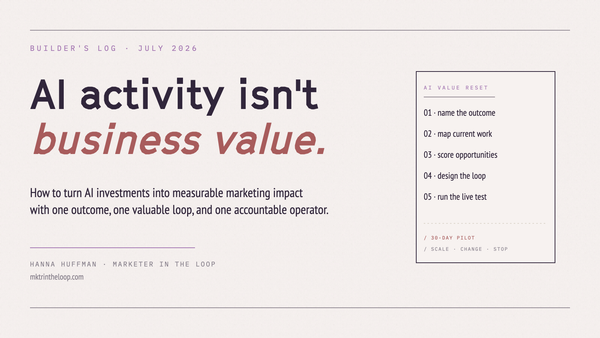
The whole point of the work I wrote about in The AI Value Reset is that AI activity is not the outcome. Pipeline, margin, customer value, better decisions, and a product that is more useful to someone are outcomes. “We automated a bunch of tasks” is a status update.
I wrote the first version of this piece with my hands. Not because I could not use AI to write it. I obviously could have. I wrote it because I wanted to make something that was of me. I wanted to get away from the fucking pixels we move around all day while telling ourselves we are changing the world, when much of the time we are producing more polished output with no living point of view behind it.
I worry about what this means for junior people too, because the old path is disappearing under their feet. The production work that used to be a training ground is being solved. Not every task, not perfectly, and not at every company—but enough of it that pretending nothing has changed is terrible career advice.
Junior people now have nearly infinite world intelligence available through Google and AI, at any hour, on practically any subject. Yet managers are still getting procedural questions that could have been answered in five minutes, with no proposed answer and no point of view attached.
As my dad would say: that dog don’t hunt.
Train the AI to do the old job. Then bring something new to the table.
But businesses have a responsibility here too. You cannot automate the production queue, eliminate the apprenticeship, isolate the remaining people, and then complain that nobody has judgment.
That is how we end up with soulless, lonely work on fake problems, adding no real value to real people—and congratulate ourselves for doing it faster.
3. We need to stop settling—and make the alternative visible
The future of marketing will not be decided only by what the models can do.
It will be decided by what marketers, founders, investors, and business leaders choose to reward.
Right now, too many of us are settling.
We are settling for more output instead of more value. Copying competitors instead of creating demand. Isolated operators instead of ambitious teams. “Creative” work with no risk, originality, or emotion. Employers who claim to want great marketing but really want cheaper production. Jobs where talented people spend their lives solving fake problems.
We need to stop.
I want to work with founders and businesses that want to do marketing the real, fun, powerful way—not the frightened version where we copy competitors, automate mediocrity, and call lower headcount innovation.
I want leaders who understand that craft and commercial discipline are not opposites. The best marketers I know care about the quality of the idea and the economics underneath it. They want to make something memorable and know whether it worked.
I want companies that use AI aggressively without treating people as the inefficient residue left behind. Companies that remove the bullshit work and reinvest the recovered time in customers, judgment, experiments, relationships, and ideas worth arguing about.
Give people real problems to own. Put them in working sessions where they have to develop judgment in public. Let them get close enough to customers to care about the result. Teach them to document and improve shared workflows instead of creating six private copies of the same prompt. Hire marketers as craftspeople, not as human wrappers around an output machine.
And I want to find the other people who feel the same way.
Not to create another giant “community” where everyone broadcasts and nobody knows anyone. Something more useful than that.
A recognizable standard of work—and a network around it.
Founders who want ambitious marketing and create the conditions for it. Marketing leaders willing to protect creative risk. Operators who use AI as leverage without surrendering judgment. Junior people hungry to learn the new craft. People who hire one another, refer one another, teach one another, and make things together.
Over time, that network could become a signal.
If you are a business looking for a marketer, you know these are people who care about the craft, understand the economics, and know how to use the new technology for more than volume.
If you are a marketer looking for your next role, client, collaborator, or teacher, you know these are places where the conditions for great work actually exist.
If you are trying to build this way inside your current company, you know you are not the only one—and you have somewhere to find examples, allies, and proof.
A lighthouse for people who believe AI-native marketing can be original, human, commercially powerful, and genuinely fun.
The craft does not have to die in the past with people like my dad and grandfather, or with the early teams some of us were lucky enough to experience.
We can carry the best parts of it forward: curiosity, judgment, usefulness, originality, pride, and the feeling of capable people making something together.
The technology is not stopping us. Mostly, we are stopping ourselves.
This is where I am supposed to give you the answer
At some point, I stopped publishing pieces like this.
I wanted Marketer in the Loop to be useful, so I pushed it toward the practical: frameworks, workflows, templates, and answers you could immediately apply. I still believe deeply in that work.
But I had started treating editorial as if it were less useful than instruction. In retrospect, that was incomplete.
The tactical tells us how to work. Editorial helps us decide what work is worth doing, what kind of profession we are building, and what we should refuse to accept along the way.
We need both.
We also need to share more honestly how this moment looks and feels while we are living through it. What is exhilarating. What sort of sucks. What is disappearing. What we refuse to lose. What kind of future we actually want.
Instead, we cling to solution orientation like a security blankie.
My instinct is to end this with five principles for protecting craft in the AI era. A maturity model. A downloadable scorecard. If I can turn the discomfort into a framework, neither of us has to sit with what it means—or admit that we do not know the answer yet.
I am not going to do that here.
Some moments need to be described before they can be solved. That is not less useful than a framework. It is what gives the framework a purpose.
I do not know yet whether the thing I am describing becomes a community, a guild, a series of dinners, a working group, a group chat, or something we have not named.
I know where I want to start: by finding the people already doing this the right way.
The founders creating room for ambitious marketing. The leaders protecting craft while adopting the technology aggressively. The operators making original, commercially powerful work and having fun doing it.
Who inspires you? Where does the work still feel alive? What are you doing that is working? What have you decided not to accept? Which founders and businesses are creating the conditions for great marketers to do great work?
Reach out and tell me.
I want us to identify these people, learn from them, make their work more visible, and make it easier for them to find one another. I want ambitious marketers to find businesses that genuinely want ambitious marketing—and those businesses to recognize the people capable of delivering it.
We can fight the worst parts of this transition without rejecting the extraordinary technology driving it. We can stop settling. We can find our people and make cool things together.
Let’s make the alternative impossible to ignore.
More to come.
Help us find the people
If this resonated, share it with your network—or send it directly to a marketer, founder, investor, or business leader who still gives a shit about the craft.
Every share helps us find the people already building this future, along with the people who have been looking for it and did not know where to begin.
About Marketer in the Loop
Marketer in the Loop shows how an AI-native marketing practice gets built: what worked, what broke, and what you can use in your own system. It is published by MultiplAI Growth Partners, which helps agencies and marketing teams turn scattered AI experiments into working systems.